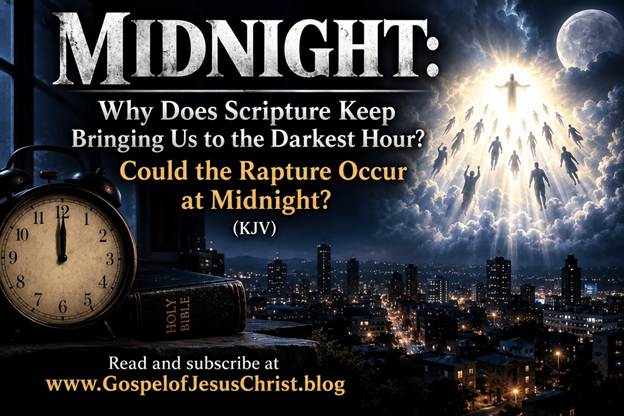
Sept 5, 2026 | www.GospelofJesusChrist.blog | River Wilde
There is one little word in the Bible that we may read without giving it much thought: midnight. Yet when we begin tracing that word through Scripture, something fascinating emerges.
Midnight repeatedly appears at moments when circumstances suddenly change. People are waiting. Darkness surrounds them. Deliverance seems distant. Then, sometimes without warning, God acts. Prison doors open. Judgment falls. A bridegroom arrives. The night reaches its deepest point—and everything changes.
That makes the words of Jesus in the parable of the ten virgins particularly interesting. Matthew 25:6 — KJV says, “And at midnight there was a cry made, Behold, the bridegroom cometh; go ye out to meet him.”
Why did Jesus place the arrival of the bridegroom at midnight? Was midnight simply part of the story, or was Jesus using the darkness of night to communicate something deeper about waiting, watching and His eventual return?
Scripture does not say that the Rapture will literally occur at midnight. In fact, because the earth has different time zones, it cannot simultaneously be midnight everywhere. Nor does the Bible give us permission to turn every occurrence of midnight into an end-times prophecy. But biblical imagery matters, and when the same imagery appears repeatedly at important moments, it is worth investigating.
The parable of the ten virgins begins with people waiting for the bridegroom. Matthew 25:1 — KJV says, “Then shall the kingdom of heaven be likened unto ten virgins, which took their lamps, and went forth to meet the bridegroom.”
Five were wise and five were foolish. The wise took oil with their lamps; the foolish did not adequately prepare. But then Jesus includes a detail that sounds remarkably familiar to anyone who has ever wondered why Christ has not yet returned. Matthew 25:5 says, “While the bridegroom tarried, they all slumbered and slept.”
The bridegroom tarried. He took longer than expected. The people waiting became tired. Eventually they slept. Nothing seemed to be happening. Then came midnight. “And at midnight there was a cry made, Behold, the bridegroom cometh.” The silence was suddenly shattered by an announcement. The waiting period was over. The bridegroom was here.
There is something beautiful about that picture. Jesus did not describe the bridegroom arriving in the brightness of midday when everyone was alert and could see him approaching from miles away. He placed his arrival in the darkness, after a period of apparent delay, when people had become sleepy. Then suddenly someone cried out: “Behold, the bridegroom cometh.”
So specifically, what does the “Delay” preceding the rapture represent?
The delay itself is part of the warning. Jesus seems to anticipate that His people will experience a period when His coming feels delayed. That delay creates a dangerous temptation to become spiritually sleepy. And precisely when people have grown accustomed to waiting—
Let me help YOU answer this question, from the perspective of those who believe and follow Jesus Christ.
You have known about the rapture for quite some time now. Even if you were not taught specifically about the rapture, you have believed that Jesus Christ was going to return in the last days. HAS THIS EVENT SEEMED DELAYED TO YOU? I can personally answer this question with a solid “YES!”
Those of us who study “End Times” Bible prophecy have expected that rapture to first happen 9 years ago, September 23, 2017, when the prophecy of Revelation 12 “woman clothed with the sun” astronomical alignment occurred.
Then again last year, during the feast of Trumpets 2025, many prophecy students expected the Rapture because several interesting ideas seemed to converge. This was the year when many began to make the connection that the rapture would actually be tied to the Feast of Trumpets
The Feast of Trumpets centers on trumpet blasts (Leviticus 23:24), while the Rapture is described with “the trump of God” (1 Thessalonians 4:16–17) and “the last trump” (1 Corinthians 15:51–52).
The Feast of the Trumpet holiday was actually referred to “The day that no man knows the day nor the hour,” because it was not known in earlier times, until two witnesses observed the New Moon in the sky, which would officially start the holiday.
Many Christians see Christ fulfilling the spring biblical feasts during His first coming, leading some to believe the autumn feasts could picture events surrounding His return.
Social Media certainly indicated that MANY were expecting this to be the YEAR of the rapture. Specific predictions circulating online greatly increased expectations for a 2025 Rapture.
To ME, this represents the DELAY, that Christ spoke about in His tarry, as He prepared to meet the bridegroom. We, have satisfied this exact expectation that Jesus mentioned which we would have prior to His return. We indeed have felt that the rapture has been “delayed,” just as He predicted that we would.
That may be the deepest lesson of the delay: the bridegroom’s apparent tarrying is not permission to stop watching. It is the very reason Jesus tells us to keep watching.
Could that contain a spiritual message for the generation awaiting Jesus Christ for the Rapture? Perhaps the greatest danger is not that Christians will stop believing in Christ altogether. Perhaps the danger is that after waiting for so long, they simply become spiritually sleepy.
Jesus repeatedly warned against exactly that. Mark 13:35–37 — KJV says, “Watch ye therefore: for ye know not when the master of the house cometh, at even, or at midnight, or at the cockcrowing, or in the morning: Lest coming suddenly he find you sleeping. And what I say unto you I say unto all, Watch.”
Notice that Jesus again mentions midnight, and again the warning concerns sleeping and being unprepared for a sudden arrival.
But Matthew 25 is not the first time something extraordinary happened at midnight. Long before the parable of the virgins, we find one of the most dramatic midnight events in the entire Old Testament—the final plague upon Egypt.
Israel had been enslaved. Pharaoh repeatedly refused God’s command to let His people go. Plague after plague came upon Egypt, yet Pharaoh’s heart remained hardened. Finally came the night of Passover. The Israelites were instructed to place the blood of the lamb upon their houses. Then Scripture tells us precisely when judgment fell.
Exodus 12:29 — KJV says, “And it came to pass, that at midnight the LORD smote all the firstborn in the land of Egypt, from the firstborn of Pharaoh that sat on his throne unto the firstborn of the captive that was in the dungeon; and all the firstborn of cattle.”
At midnight, everything changed.
For Egypt, midnight brought judgment. For God’s people, that same night brought deliverance. The blood of the lamb marked those who belonged to God, and afterward Israel began its departure from bondage. One group experienced judgment while another experienced deliverance. That contrast alone makes the midnight imagery fascinating when considered alongside the return of Christ.
There is also an obvious Gospel picture in Passover that the New Testament itself gives us. 1 Corinthians 5:7 — KJV says, “…For even Christ our passover is sacrificed for us.”
The Israelites were protected through the blood of the lamb. We are saved through Jesus Christ, the Lamb of God. We should not force every detail of Exodus into a prophecy of the Rapture, but the larger biblical picture is difficult to miss: darkness covered the land, judgment arrived, God’s people were protected, and their deliverance from bondage followed.
Midnight appears again in the story of Ruth, and this occurrence is much quieter but equally interesting. Ruth went to Boaz, her kinsman-redeemer, and Ruth 3:8 — KJV says, “And it came to pass at midnight, that the man was afraid, and turned himself: and, behold, a woman lay at his feet.”
The story ultimately leads toward Boaz taking Ruth as his wife. Christians have long seen beautiful pictures of redemption in the account of Ruth and Boaz. Boaz is the kinsman-redeemer; Ruth comes to him seeking refuge; and redemption eventually leads to marriage. Once again, interestingly, midnight appears in a story involving a redeemer and a bride.
Then we come to another remarkable midnight event in the New Testament. Paul and Silas had been beaten and thrown into prison. Their feet were fastened in stocks. Humanly speaking, their situation looked hopeless. Yet Acts 16:25 — KJV tells us, “And at midnight Paul and Silas prayed, and sang praises unto God: and the prisoners heard them.”
Think about that scene. It was midnight. They were injured. They were imprisoned. They could not see any obvious means of escape. Yet instead of surrendering to despair, they prayed and sang praises to God.
Then suddenly everything changed. Acts 16:26 — KJV says, “And suddenly there was a great earthquake, so that the foundations of the prison were shaken: and immediately all the doors were opened, and every one’s bands were loosed.”
There is that pattern again. Darkness. Waiting. Faith. Then suddenly—divine intervention. Doors opened and chains fell away.
That word “suddenly” is worth remembering because Scripture frequently associates God’s future intervention with unexpectedness. Paul writes in 1 Thessalonians 5:2–3 — KJV, “For yourselves know perfectly that the day of the Lord so cometh as a thief in the night. For when they shall say, Peace and safety; then sudden destruction cometh upon them…”
Jesus likewise warned that His coming could catch people unaware. The biblical message is not that believers should calculate an exact midnight on a particular calendar date. The message is that God’s intervention may occur when the world is least expecting it.
There is another midnight event that carries a very different warning. Judges 16:3 — KJV tells us that Samson “lay till midnight, and arose at midnight, and took the doors of the gate of the city…”
Samson arose during the darkness and carried away the very gates that were supposed to confine him. Once again midnight becomes associated with an unexpected reversal. What looked secure was suddenly broken open.
Even the Psalms use midnight as a time of spiritual devotion. David declared in Psalm 119:62 — KJV, “At midnight I will rise to give thanks unto thee because of thy righteous judgments.”
While others slept, the Psalmist rose to worship God. That creates another beautiful connection with Christ’s repeated command to watch. Midnight can represent the time when most people are asleep, yet the faithful servant remains spiritually awake.
This brings us back to the question: Could midnight symbolize more than a time on the clock?
Throughout Scripture, darkness often carries spiritual meaning. Jesus said in John 3:19 — KJV, “And this is the condemnation, that light is come into the world, and men loved darkness rather than light…”
Paul likewise warned believers about spiritual darkness while speaking specifically about the coming Day of the Lord. 1 Thessalonians 5:4–5 — KJV says, “But ye, brethren, are not in darkness, that that day should overtake you as a thief. Ye are all the children of light, and the children of the day…”
Perhaps this helps us understand why midnight is such a powerful setting for the arrival of the bridegroom. Midnight represents the depth of night. If we think of it symbolically, it is the point at which darkness appears to have completely taken over. Yet midnight also contains a wonderful truth that is easy to overlook: once midnight arrives, the night is already moving toward morning.
That may be one of the most beautiful pictures in this entire study.
The darkest hour does not mean the sun will never rise. It means morning is approaching.
Could the world become spiritually darker immediately before Christ’s return?
Scripture certainly warns that the last days will contain serious wickedness and deception. 2 Timothy 3:1 — KJV says, “This know also, that in the last days perilous times shall come.”
Paul continues by describing people as lovers of themselves, lovers of money, proud, unthankful, unholy and lovers of pleasures more than lovers of God. Jesus warned in Matthew 24:12, “And because iniquity shall abound, the love of many shall wax cold.”
The Bible therefore does not describe the world gradually becoming so righteous that humanity eventually welcomes Christ back. Instead, Scripture repeatedly warns about deception, apostasy, wickedness and spiritual sleep. That makes the midnight picture even more interesting. Perhaps Christ’s arrival comes not when the world has finally created enough light of its own, but when humanity discovers just how dark the world can become without Him.
There is another important part of the parable of the ten virgins that we cannot overlook. When the midnight cry came, there was no longer time for the foolish virgins to make the preparations they should have made earlier. Matthew 25:10 — KJV says, “And while they went to buy, the bridegroom came; and they that were ready went in with him to the marriage: and the door was shut.”
Those words should remind us of Noah. Noah entered the ark, and Genesis 7:16 tells us, “…and the LORD shut him in.” In Matthew 25, those who were ready entered with the bridegroom, “and the door was shut.” In both stories there was a period of preparation followed by a point at which the opportunity represented by the open door ended.
This does not mean we should live terrified that we might accidentally miss Jesus because we misunderstood some prophetic calculation. Salvation rests in Jesus Christ, not in our ability to solve a prophetic puzzle. But it does mean that Jesus wants us spiritually awake. The point of prophecy is not merely to produce charts, dates and arguments. It is to cause us to recognize the seriousness of the time and place our confidence completely in Christ.
Perhaps we should therefore think differently when the world appears to be getting darker. Darkness can be frightening, especially when we see wars, hatred, deception, violence, confusion and people increasingly rejecting God. But for the believer, increasing darkness should never cause us to believe that darkness has won.
Jesus Christ is the Light.
John 8:12 — KJV says, “I am the light of the world: he that followeth me shall not walk in darkness, but shall have the light of life.”
Think again about the midnight pattern we have discovered. At midnight in Egypt, judgment came and God’s people moved toward deliverance. At midnight in Ruth, we find a woman at the feet of her kinsman-redeemer in a story that ultimately leads to marriage. At midnight Paul and Silas prayed and sang until suddenly the prison shook, doors opened and chains fell away. At midnight the Psalmist arose to praise God. And in the words of Jesus, at midnight a cry suddenly breaks through the darkness:
“Behold, the bridegroom cometh; go ye out to meet him.”
Perhaps there is a message in all of this.
When the night becomes darkest, do not stop watching.
When the Bridegroom seems to tarry, do not stop believing.
When the world appears increasingly consumed by darkness, do not assume God has lost control.
When everyone around you appears spiritually asleep, keep your eyes upon Jesus Christ.
We cannot say from these passages that the Rapture will occur at literal midnight. Scripture does not tell us that. Nor can we say exactly how dark the world must become before Christ gathers His people. But we can say something with confidence: Jesus intentionally used the image of a delayed bridegroom arriving suddenly in the darkness, and He repeatedly warned His followers to remain watchful.
There will eventually be a moment when waiting becomes arrival.
There will be a moment when prophecy becomes history.
There will be a moment when those who have spent years saying, “Where is the promise of his coming?” will no longer be able to ask that question.
And perhaps, spiritually speaking, that moment comes at midnight—when the world appears darkest, when the Bridegroom seems to have tarried, when many have fallen asleep, and when those who are still watching may wonder how much longer the night can possibly continue.
Then comes the cry:
“BEHOLD, THE BRIDEGROOM COMETH.”
Midnight means a new day has already begun.
The clock crosses twelve while darkness still surrounds us. Nothing outside may appear different. The streets are still dark. Most of the world is still sleeping. The sunrise has not yet appeared over the horizon.
But according to the calendar, the old day is already over.
The new day has begun.
What a beautiful picture that provides for those waiting for Jesus Christ. The world may look dark. Evil may appear powerful. The Bridegroom may appear to be tarrying. The night may seem extraordinarily long.
But darkness does not get the final word. Morning is coming. The King is coming. And one day, at the moment appointed by God, the long wait will suddenly be over. Until then, the command of Jesus remains remarkably simple.
Mark 13:37 — KJV
“And what I say unto you I say unto all, Watch.”
And perhaps someday the next words we hear will be the words Jesus placed at the darkest hour:
Matthew 25:6 — KJV
“And at midnight there was a cry made, Behold, the bridegroom cometh; go ye out to meet him.”
I can personally witness to all of you, that He is coming VERY SOON to rapture those who are “in Christ.”
1 Thessalonians 4:16–18 — KJV
“For the Lord himself shall descend from heaven with a shout, with the voice of the archangel, and with the trump of God: and the dead in Christ shall rise first:
Then we which are alive and remain shall be caught up together with them in the clouds, to meet the Lord in the air: and so shall we ever be with the Lord.
Wherefore comfort one another with these words.”
Discover more from The Gospel of Jesus Christ
Subscribe to get the latest posts sent to your email.


I believe Jesus will return at the mid night hour in Jerusalem and it will be 6pm here on the east coast of USA.
so I’m always looking up at that time of day waiting and watching , but if nothing happens that day I’m in prayer and bible reading that night withing again for tomorrow 🙏
LikeLiked by 1 person
I like your style.. wink, wink =)
LikeLike