August 14, 2026 | www.gospelofjesuschrist.blog | River Wilde
Yesterday, I heard some discussion where a devote church member was basing the entire gospel of Jesus Christ upon this scripture:
James 2:26 (KJV)
“For as the body without the spirit is dead, so faith without works is dead also.”
The basis of his point was that this scripture demonstrates that it is ALL up to us, and our works. A person cannot just have faith to be saved; it must also include works for salvation.
So, what does this scripture really mean? What was the context in which James declared such a statement? Once again, it’s time to “investigate”.
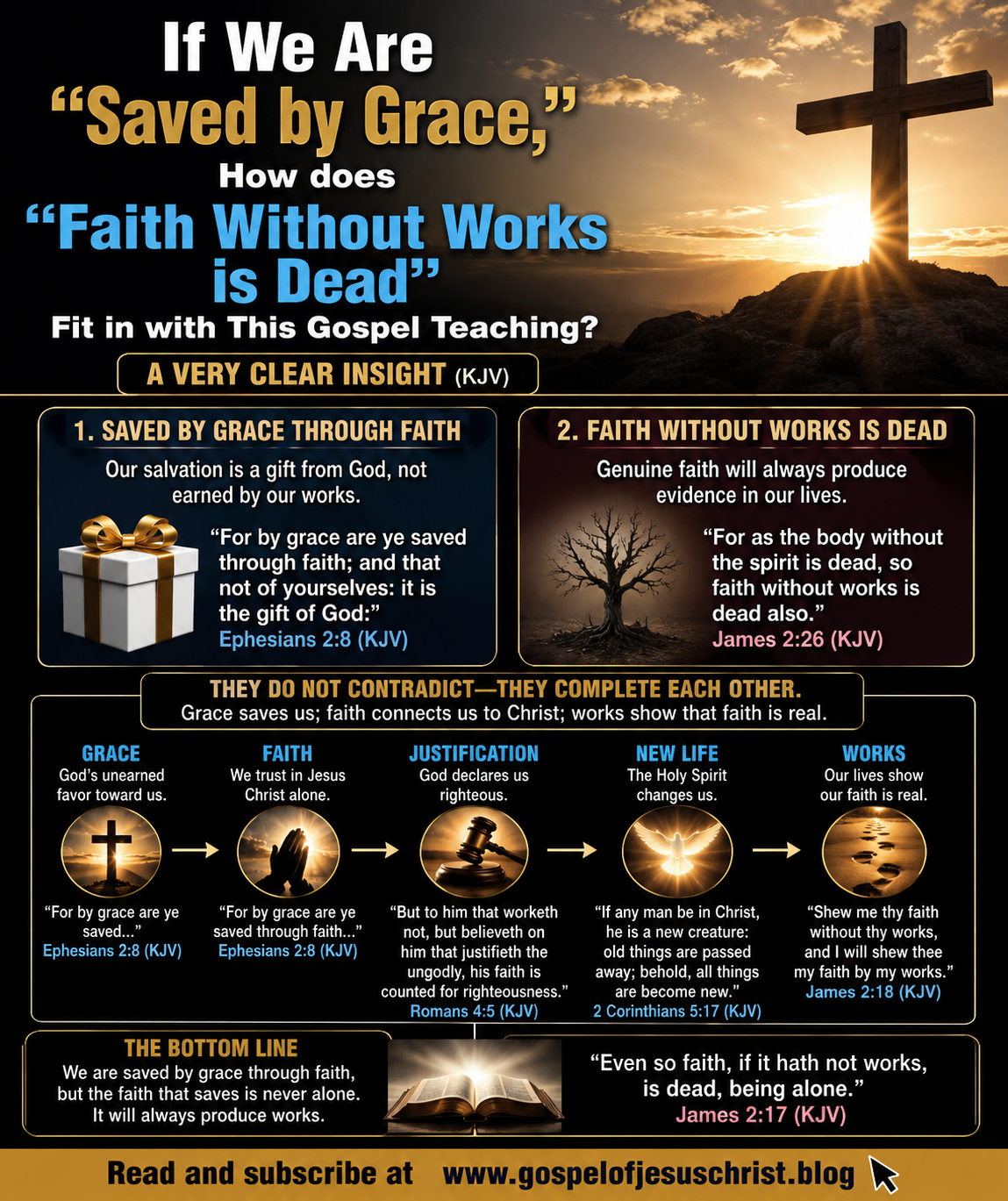
James’s statement that “faith without works is dead” does not contradict Paul’s teaching that we are saved by grace through faith, not by works. The key is understanding the difference between works as the cause of salvation and works as the evidence of salvation. Let’s look deeper into what Paul was teaching in HIS teaching.
We are saved by grace—not by works
Paul could hardly make this clearer:
Ephesians 2:8–9 (KJV)
“For by grace are ye saved through faith; and that not of yourselves: it is the gift of God:
Not of works, lest any man should boast.”
Salvation is a gift. We cannot earn it through obedience, religious ordinances, charitable acts, church attendance, or good behavior.
Paul says the same thing again:
Titus 3:5 (KJV)
“Not by works of righteousness which we have done, but according to his mercy he saved us…”
And, a similar teaching in the book of Romans:
Romans 4:5 (KJV)
“But to him that worketh not, but believeth on him that justifieth the ungodly, his faith is counted for righteousness.”
Initially this scripture might be a bit confusing to read, so let’s put it in today’s language.
The phrase “to him that worketh not” is especially powerful because Paul is emphasizing someone who is not relying upon his works to earn righteousness.
A modern-language rendering of this scripture could be:
“A person who has done nothing to earn salvation can still be made right with God simply by believing in Jesus Christ. God counts that person’s faith as righteousness, rather than requiring good works to earn it.”
That is extremely important. The sinner is justified by believing upon Christ, not by accumulating enough good works.
Then what does James mean?
James writes, a clarifying statement prior to declaring “faith without works is dead”:
James 2:17–18 (KJV)
“Even so faith, if it hath not works, is dead, being alone.
Yea, a man may say, Thou hast faith, and I have works: shew me thy faith without thy works, and I will shew thee my faith by my works.”
Notice the word “shew.”
James is talking about a faith that becomes visible.
You cannot physically see another person’s faith. But you can see what that faith produces. Genuine faith in Jesus Christ begins changing a person’s desires, actions, priorities, love for others, and relationship with sin.
Therefore:
We are not saved BY good works; good works should come BECAUSE we have been saved.
Can you see the connection here? Faith in salvation offered through Jesus Christ ALWAYS produces GOOD WORKS! It is a visible sign demonstrating that a person has FAITH! And to continue with that thought, if a person does NOT have good works, it is EVIDENT that they do not have Faith. If that person does not have a “New Life” because of the spiritual rebirth of becoming born again, which produces “Good Works” it is again evident that they did not have the Faith necessary in believing in the atonement of Jesus Christ.
Simply put – Faith always produces good works, and faith without works is “Dead” (evidence that a person does not have faith.)
Let’s keep searching to further prove what is being taught here.
Further evidence is actually contained in the very next verse after Paul’s famous statement about salvation by grace:
Ephesians 2:10 (KJV)
“For we are his workmanship, created in Christ Jesus unto good works, which God hath before ordained that we should walk in them.”
When we become a child of God, through this rebirth of the spirit, we are the workmanship of our creator. And HE has made us DESIRE to do good works when we belong to Him.
The order of this teaching of the Gospel of Jesus Christ matters:
Grace → Faith → Salvation → Good works
Not:
Good works → Salvation
Let’s continue…Abraham is a perfect example. James points to Abraham again in the scriptures:
James 2:21–22 (KJV)
“Was not Abraham our father justified by works, when he had offered Isaac his son upon the altar?
Seest thou how faith wrought with his works, and by works was faith made perfect?”
Abraham’s willingness to offer Isaac did not purchase his salvation. His obedience demonstrated the reality of the faith he already possessed.
Further teachings from James helps us understand:
James 2:26 (KJV)
“For as the body without the spirit is dead, so faith without works is dead also.”
James is confronting a person who merely claims to have faith while nothing in that person’s life demonstrates it. This becomes very clear now. He isn’t teaching that Christ’s atonement needs our works added to it before it becomes sufficient.
I believe that one of the very most profound teaching of the Gospel of Jesus Christ is consistently glossed over. The “shortest story” in the bible, to me, has some of the most significant teachings… Can you guess what story that might be?
The Thief On the Cross!
The thief beside Jesus had virtually no opportunity to perform religious works. Yet after turning to Christ, Jesus told him:
Luke 23:43 (KJV)
“Verily I say unto thee, To day shalt thou be with me in paradise.”
He was saved because he placed his faith in Christ—not because he completed a lifetime of works.
This dramatic teaching was from the very WORDS of Jesus Christ. We LEARN this concept is such a simple first-hand experience that this thief had with the Savior Himself, recorded in scripture.
The thief wasn’t baptized, did not pay tithing to a church, didn’t belong to a religion, didn’t have to complete “requirements” that a church demands. He recognized that he was a sinner and needed Jesus Christ to save him through His title of a Savior, asking for forgiveness.
Is there any evidence that suggest that the thief was indeed born again, since he only had a matter of moment before he died?
The evidence that the thief on the cross had experienced a spiritual change consistent with being born again can be seen in the dramatic change in his heart and words.
He began to fear God, saying, “Dost not thou fear God?”; he confessed his own guilt, admitting, “we indeed justly” deserved punishment; he recognized the innocence of Jesus, declaring, “this man hath done nothing amiss”; and most importantly, he turned personally to Jesus in faith, calling Him “Lord” and believing that, despite seeing Him dying on a cross, Jesus would still come into His kingdom (Luke 23:40–42 KJV).
These actions did not earn the thief salvation; rather, they were outward evidence that something had changed within him. Jesus Himself confirmed the reality of his faith by answering, “To day shalt thou be with me in paradise” (Luke 23:43).
The thief had virtually no time to perform good works, yet the faith within him immediately began producing visible fruit—evidence of a changed heart.
Such a Short Story, yet so profound!!!
Life can be so complicated and emotionally damaging when a religion teaches that we must do MORE good works to make it into heaven. Serve MORE, pay MORE tithing, go to the temple MORE. More, More, More!
This is so conflicting with the Gospel of Jesus Christ. Our faith in Him and His atoning sacrifice is what saves us! PERIOD!!! And because of our faith in Him, good works will always follow as EVIDENCE that we have become a new spiritually reborn individual.
We do good works because of the SPIRIT of God that now resides within us. We answer the promptings that He gives us to reach out and serve others who need our help. Our desire to sin is DRASTICALLY reduced because of that same spirit that dwells within us, NOT because a religion tells us the things that we can and can’t do.
A person is better served by thinking to themselves, “How can I increase my faith in Jesus Christ,” rather than, “What else do I need to do to earn my spot in heaven?”
The Gospel of Jesus Christ as taught be Jesus and His Apostles just seems to FLOW….
We go through this experience of being Born Again, which produces the knowledge that we now are a child of God, and are sealed to HIM.
We know that because of the atonement, we have no sin to carry with us after we die, and are destined to go to heaven to “..ever be with the Lord.”
We receive His spirit, and Know that His spirit dwells within us and “..not in a temple made with hands.”
Because of our spiritual rebirth, we have a tremendous desire to do good works, and serve others.
We also have a desire to do things that keep us close to Christ. Sin becomes something that we desire less, because of the spirit that dwells within us. For those times that we make mistakes, we repent for those sins, and continue trying to increase in spiritual strength to grow closer to God.
This is the Gospel of Jesus Christ, for they are HIS teachings, and not a religion’s.
I hope that this helps clarify where our Works stand in relation to our Faith. I’ve truly appreciated doing this “investigation,” and, as consistently happens whenever I study the scriptures, I ALWAYS come away having learned something new.
Discover more from The Gospel of Jesus Christ
Subscribe to get the latest posts sent to your email.

