July 19, 2026 | www.gospelofjesuschrist.blog | River Wilde
There can be many aspects of a religion which can be viewed as very positive, wholesome and good. This article is not written to challenge any of those positive things that a person experiences in their church.
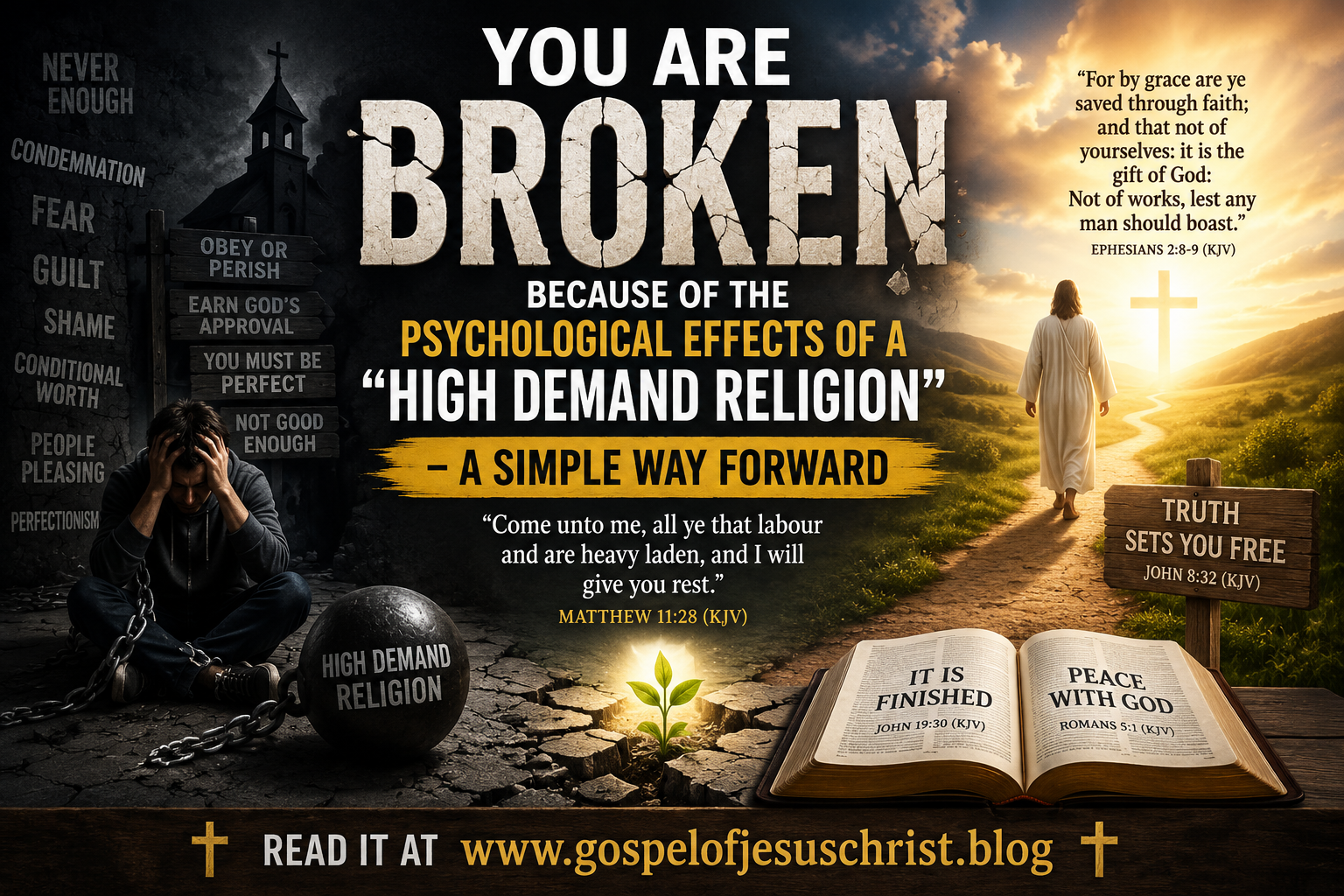
Today, I would like to discuss real medical / psychological conditions that exist for some people who are involved in a high-demand religion. Understanding what is happening in your life is a very important as a step towards healing.
Let me share with you, the terms used in psychology, trauma research, in the study of high demand groups. See if you can relate to any of these specific descriptions:
Religious Trauma Syndrome (RTS)
(RTS) is a term used by some mental health professionals and researchers to describe the emotional, psychological, and sometimes physical effects that can result from participation in—or departure from—a high-demand or authoritarian religious environment.
Individuals experiencing religious trauma may struggle with chronic anxiety, persistent feelings of shame or guilt, perfectionism, fear of divine punishment, difficulty trusting their own judgment, and a deeply rooted belief that they are never “good enough” in God’s eyes.
Many also report an intense fear of questioning religious authority or leaving their faith community, because they have been taught that doing so could lead to spiritual ruin, the loss of loved ones, or eternal consequences.
Even after leaving the group, these fears and patterns of thinking can persist for years, making it difficult to develop a healthy sense of identity, confidence, and peace. Mental health professionals who recognize RTS often focus on helping individuals separate fear-based conditioning from their own values and beliefs so they can make spiritual and personal decisions without overwhelming anxiety or coercion.
We have only just begun breaking down destructive consequences of belonging to some churches… Let’s continue.
Phobia Indoctrination
This is the term most commonly used by cult experts such as Steven Hassan.
Phobia indoctrination is the deliberate creation of irrational fears to keep members compliant. Examples include:
- Fear of leaving the group.
- Fear of disappointing God.
- Fear that questioning leaders will lead to spiritual destruction.
- Fear that salvation depends on perfect obedience.
- Fear that one is never quite worthy enough.
The phobia doesn’t have to be about leaving the religion—it can also be a chronic fear of personal inadequacy.
So why would a church use such a concept? The answer is obvious. They are not helping members in their relationship with Jesus Christ; it is ALL ABOUT the CHURCHES CONTROL over you.
This process teaches that serious negative consequences—such as losing God’s approval, forfeiting salvation, harming one’s family, or falling under evil influences—will result from doubting leaders or departing from the group.
Whether introduced deliberately by leadership or developed gradually through the culture of the organization, these fears can make members more dependent on the institution for reassurance, guidance, and a sense of safety.
From the perspective of psychologists who study high-control groups, this can increase conformity, reduce independent thinking, and make it significantly more difficult for individuals to evaluate beliefs on their own, or leave without experiencing intense anxiety.
Let’s continue…
Conditional Worthiness
This is frequently discussed in psychology and religious studies. It describes the belief that:
“I am only worthy of love, acceptance, or salvation if I perform well enough.”
People raised with this mindset often develop perfectionism and constant self-doubt. This is the belief that a person’s acceptance by God, or their value within a religious community, depends on continually meeting specific standards of behavior, obedience, or performance.
Instead of resting in a secure relationship with God, individuals may come to feel they are never quite good enough and must constantly prove themselves. Is this making sense to you?
In some high-demand religious environments, emphasizing conditional worthiness can encourage members to remain highly committed, obedient, and engaged in the practices and expectations of the organization.
While many religious communities sincerely teach high moral standards out of conviction rather than control, critics and researchers of high-control groups argue that when acceptance is made to feel conditional on continual performance, it can foster dependence on the institution and make members less likely to question its authority or teachings.
It is easy to distinguish between the two.
Separate your relationship with the church and your relationship with God. These are, and always should be TWO Separate relationships. In processing your emotions regarding conditional worthiness, how do you think that God feels about what you are doing…NOT just how the church makes you feel. We’ll talk more about this with the teachings of Jesus Christ at the end of this article.
Scrupulosity
I must share something very personal with all of you. This condition was a TREMENDOUS challenge for me throughout my life, because of my church. It was always in my thoughts throughout my live, which created such a mental challenge for me each day. Let me explain this to you.
Scrupulosity is a form of obsessive-compulsive disorder (OCD) focused on religious or moral concerns. A person may experience:
- Constant worry that they’ve sinned.
- Repeated confession or repentance.
- Fear they haven’t done enough.
- Feeling guilty even when they have done nothing wrong.
Unlike normal religious conviction, scrupulosity is driven by anxiety rather than healthy faith. Those who experience scrupulosity often live with an overwhelming fear that they have sinned, offended God, or failed to meet His expectations—even when there is little or no objective reason to believe they have done so.
They may repeatedly confess the same sins, seek constant reassurance from religious leaders, pray compulsively, or continually question whether they have repented sincerely enough or possess enough faith to be accepted by God.
Living with scrupulosity can be emotionally exhausting, as the individual may feel trapped in an endless cycle of fear, guilt, and self-examination that steals the joy, peace, and assurance that many faith traditions teach should accompany a healthy relationship with God.
While scrupulosity is a recognized form of obsessive-compulsive disorder and cannot be attributed solely to a religious organization, the environment in which a person’s faith develops can significantly influence how the condition is expressed.
Mental health professionals have observed that religious settings emphasizing constant self-examination, fear of divine punishment, perfectionism, or the belief that one is never fully worthy may intensify scrupulous thoughts and behaviors in individuals who are predisposed to OCD.
In these cases, the disorder is not created by the church itself, but certain teachings, messages, or cultural expectations may reinforce the person’s fears and make recovery more difficult. For this reason, many therapists encourage addressing both the underlying OCD and the religious beliefs or practices that may be fueling the cycle of anxiety and reassurance-seeking.
Perfectionism
Many high-demand religions unintentionally or intentionally foster maladaptive perfectionism:
- “I must never fail.”
- “God only accepts me if I keep improving.”
- “I’m never measuring up.”
This often leads to chronic shame.
Shame-Based Religious Conditioning
Many counselors use this phrase to describe systems where a person’s identity becomes:
“I am fundamentally inadequate unless I continually prove my worth.”
This differs from healthy guilt (“I did something wrong”) because shame says:
“I am wrong.”
In the context of high-demand religions
Researchers who study high-control groups often describe a cycle like this:
- The group establishes an impossible ideal.
- Members inevitably fall short.
- They experience guilt and shame.
- The CHURCH offers itself as the solution.
- The cycle repeats.
This pattern can create a persistent fear of never being good enough, even in highly devoted members.
The Solution
From my perspective, the solution to fear-based religion is to return to the simple gospel that Jesus Christ taught during His earthly ministry.
Again and again, Jesus invited people to come to Him—not because they had achieved perfection, but because they recognized their need for a Savior.
He offered rest to the weary (Matthew 11:28–30), declared that eternal life is received by believing on Him (John 3:16; John 6:47), and assured those who trusted in Him that their sins were forgiven.
The gospel Jesus preached replaces fear with peace, uncertainty with assurance, and the exhausting pursuit of proving one’s worth with the confidence that salvation is the gift of God’s grace, received through faith.
In my view, when believers anchor their faith in Christ’s finished work on the cross, rather than in continual efforts to earn acceptance, they find the freedom, joy, and security that Jesus intended for His followers.
High-demand religions focus on our works and actions, but that is not what Jesus taught.
Ephesians 2:8–9 (KJV)
“For by grace are ye saved through faith; and that not of yourselves: it is the gift of God:
Not of works, lest any man should boast.”
The gospel that Jesus Christ proclaimed is a gospel of grace, not works. The Bible teaches that no one can earn salvation through good deeds, religious rituals, or personal righteousness because every person has sinned and falls short of God’s perfect standard (Romans 3:23).
Instead, salvation is God’s free gift, purchased entirely by the death, burial, and resurrection of Jesus Christ. When a person places their faith in Christ alone, trusting that His sacrifice fully paid for their sins, God forgives them, declares them righteous, and gives them eternal life.
Good works are the result of genuine faith, but they are never the means by which a person is saved. No person can EARN their way into heaven…NOT ONE!
Can you see the teachings of Jesus Christ compared to the teachings of your church? The church is telling you that your salvation depends upon your own works, and that you must keep trying for perfection. It is your responsibility to earn your way to heaven. (No wonder we are all so stressed out!!!!!)
The Gospel that Jesus taught is that salvation (living with Jesus Christ forever in heaven) is a gift, earned by Him alone, and available to all who accept His atonement—or, as He explained it, to those who are born again.
Jesus did not teach that eternal life must be earned through religious performance, personal merit, or a lifetime of proving oneself worthy. Instead, He taught that fallen sinners, which includes all of us, could be forgiven because of what Jesus Christ did for all of us…His atonement.
Through His death on the cross, His burial, and His resurrection, He paid the full penalty for our sins. When a person places their trust in Him alone, (not their church, or even their good works) God grants forgiveness, eternal life, and the indwelling Holy Spirit. Good works then become the natural fruit of a transformed life, not the price paid to obtain salvation.
Other excellent KJV passages supporting salvation by grace through faith include:
- Romans 3:28 – “Therefore we conclude that a man is justified by faith without the deeds of the law.”
- Romans 4:5 – “But to him that worketh not, but believeth on him that justifieth the ungodly…”
- Titus 3:5 – “Not by works of righteousness which we have done, but according to his mercy he saved us…”
- Galatians 2:16 – “…a man is not justified by the works of the law, but by the faith of Jesus Christ…”
- John 6:28–29 – Jesus identifies the “work of God” as believing on the One whom God sent.
- Romans 11:6 – “And if by grace, then is it no more of works…”
- 2 Timothy 1:9 – God “hath saved us… not according to our works, but according to his own purpose and grace.”
These passages together present a consistent New Testament theme that salvation is received by God’s grace through faith, while good works follow as the fruit of a transformed life rather than the basis for acceptance before God.
Yes, it is that easy! We cannot earn our way into heaven, for it is impossible because we all have sinned and fall short. But Jesus Christ came to earth, and died for our sins so that we can be forgiven. The atonement is for all mankind but it is not forced upon anyone. Each person must choose to accept it or reject it.
So, to all of you who have experienced religious trauma, I invite you to study the Gospel that Jesus Christ taught while on earth as recorded in the New Testament. You will find that it is NOT the same gospel that your church is teaching you
Sadly, I have learned through my own studies, and my own personal belief that the church is a business using religion for monetary gain, rather than an organization that is trying to assist people in following the gospel of Jesus Christ. This becomes so evident when you compare the gospel of Joseph Smith compared to the Teachings of Christ and His apostles as recorded in the New Testament.
I give my personal testimony of this teaching, for this has been my very own experience:
John 8:31–32 (KJV):
“Then said Jesus to those Jews which believed on him, If ye continue in my word, then are ye my disciples indeed;
And ye shall know the truth, and the truth shall make you free.”
I now know, as many others know as well, that because I have accepted the Gift from Jesus and become Born Again, I will be going to heaven when I die. Can you even IMAGINE how comforting this knowledge is to me?
I no longer have to worry if I am good enough. Jesus Christ has already made heaven possible for me because of His atonement.
Romans 5:1 (KJV)
“Therefore being justified by faith, we have peace with God through our Lord Jesus Christ:”
John 14:27 (KJV)
“Peace I leave with you, my peace I give unto you: not as the world giveth, give I unto you. Let not your heart be troubled, neither let it be afraid.”
Jesus promises His own peace to those who belong to Him.
Colossians 1:20 (KJV)
“And, having made peace through the blood of his cross, by him to reconcile all things unto himself…”
Our peace with God was accomplished through Christ’s sacrifice.
Isaiah 26:3 (KJV)
“Thou wilt keep him in perfect peace, whose mind is stayed on thee: because he trusteth in thee.”
Trusting God produces peace.
Yes, therapy can help you deal with religious trauma, but not nearly as effective as studying the true teachings of Jesus Christ. Good luck to all of you.
Discover more from The Gospel of Jesus Christ
Subscribe to get the latest posts sent to your email.


Thank you for writing this and expressing such an important message. I am sure the Lord will use it to help others understand the peace and rest that can be found in Jesus Christ as He sets them free and lifts them from out under the oppressive burden of religious performance and bondage.
LikeLiked by 1 person
Amen!!
LikeLike
It’s devasting for a person to learn and to see how they have been deceived by a religous organixation or someone they trust. I can relate to the psychological damage that hsppens when they learn the truth, then turn away from the lies and deceit they experienced. The loneliness one feels when loved ones and friends turn against you is heartbreaking. I think it’s best to make a clean break from them and be born again, be in Christ, accept the Attonement and the gift of salvation from our loving Father. What a wonderful feeling it is to know that Christ accepts you, forgives you and looks forward to greeting you when we are called up the meet him.
Toivo
LikeLiked by 1 person
Amen!
LikeLike