May 17, 2026 | www.gospelofjesuschrist.blog | River Wilde
Yesterday was a perfect day. We had packed our kayaks into a mountain lake to enjoy some relaxing time fishing. To leave behind all of the stresses of life for the day, and be at peace in our own minds. The water was clear, flat, and without a ripple, which encouraged a deeper desire to retreat into a spiritual realm.
Out of nowhere, for the first time in many, many years, I began to sing a song that was popular in the early 1970s, “The Lord’s Prayer” performed by Sister Janet Mead. Do any of you recall this song?A trendy, upbeat expression of worship.
While I was singing, the words were as if I was hearing them for the first time. Each phrase invoked a deep meaning, and it was at that moment that I realized that I was being taught something very special.
“Our Father which art in heaven, Hallowed be thy name.”
The prayer begins with relationship.
Jesus did not teach believers to approach God as strangers, but as children approaching their Father. Through faith, believers are invited into a personal relationship with the Creator of the universe.
The phrase “Our Father” also teaches unity among believers. We are not alone in our faith journey. God is building a family of believers from every nation and background.
“Hallowed be thy name” means that God’s name is holy, sacred, and worthy of reverence. Before asking for anything, Jesus teaches us to worship God and recognize His greatness.
The first lesson of the Lord’s Prayer is this:
God is holy, and we are to approach Him with reverence and humility.
“Thy kingdom come. Thy will be done in earth, as it is in heaven.”
This portion of the prayer teaches surrender. A topic that would take me personally, a lifetime to understand and implement, in my somewhat prideful personality.
Humanity naturally desires its own will, its own plans, and its own control. Yet Jesus taught believers to desire God’s kingdom above earthly kingdoms and God’s will above personal desires.
To pray “Thy kingdom come” is to long for the reign of righteousness, truth, justice, and ultimately the return of Jesus Christ Himself.
To pray “Thy will be done” requires trust. It means yielding our own ambitions and accepting that God’s wisdom is greater than our own understanding.
This teaching stands in direct opposition to pride and self-centered living.
The believer is called to seek God’s purposes first. Where are you in this invitation?
“Give us this day our daily bread.”
Jesus teaches dependence upon God.
“Daily bread” represents both physical and spiritual provision. Just as Israel received manna one day at a time in the wilderness, believers are taught to trust God day by day.
This prayer encourages us not to live in anxiety or fear about the future, but to trust that God already knows our needs. As we learn to rely upon Him, our relationship with Him grows deeper and stronger. At first, this kind of trust may feel uncomfortable, especially for those who are used to depending completely upon themselves and taking care of every need on their own. Yet learning to trust God is a very important part of our relationship with Him.
Jesus later taught:
“Take therefore no thought for the morrow…”
— Matthew 6:34 (KJV)
The lesson here is profound:
God desires His children to trust Him continually rather than rely completely upon worldly security.
This also teaches gratitude. Every blessing—food, shelter, strength, peace, and life itself—ultimately comes from God.
“And forgive us our debts, as we forgive our debtors.”
This is one of the most challenging teachings in the prayer for some. Are you ready to see where you stand with this directive?
Jesus teaches that forgiven people should become forgiving people.
Sin creates a debt before God that humanity cannot repay. Through Christ, forgiveness becomes available by grace. Yet believers are also warned against holding bitterness, hatred, and unforgiveness toward others.
Immediately after the Lord’s Prayer, Jesus emphasized this teaching:
“For if ye forgive men their trespasses, your heavenly Father will also forgive you:”
— Matthew 6:14 (KJV)
Forgiveness does not mean approving evil or pretending wounds do not exist. Rather, it means releasing vengeance and entrusting judgment to God.
Unforgiveness hardens the heart. Forgiveness reflects the mercy of Christ.
I often think of the gratitude that I have personally, that God and others have forgiven me for what wrongs that I have done in my life. I also have been on the other end of things as well. To be deceived and lied to from my religion was a difficult one for me to let go of.
One night in prayer, I was asking God how religious leaders could betray their members under the name of Jesus Christ, and on such an intimate level like the temple. At that moment, I felt that God understood the depts of my sorrow…and anger towards the church. I wasn’t telling Him something that He already did not know. At that moment, it was such a natural time for me to give that burden to Him, and forgive the church.
I wasn’t dismissing what had happened, but I was doing my part in forgiveness by giving it to God. Two scriptures came to mind:
“Dearly beloved, avenge not yourselves, but rather give place unto wrath: for it is written, Vengeance is mine; I will repay, saith the Lord.” — Romans 12:19 (KJV)
“To me belongeth vengeance, and recompence…” — Deuteronomy 32:35 (KJV)
My reflection with these scriptures wasn’t in a spiteful way, but it was reassuring that:
*God understood my sorrow that came from religious leaders using the name of Jesus Christ to deceive me, for a lifetime.
*He understood that what they had done was wrong.
*And, by giving him this burden, HE would take care of things!
Do you know how freeing this is?
That experience also began a process within me to recognize that these men had likely been deceived themselves by the adversary, and that forgiveness was still possible for them, if they were willing to come to Christ and turn away from the pursuit of wealth and power. I found myself praying that this would ultimately be the path they would choose.
Let’s Continue…
“And lead us not into temptation, but deliver us from evil:”
This part of the prayer teaches spiritual awareness.
The Christian life is not merely physical; it is spiritual warfare. Temptation, deception, sin, and evil are realities in this fallen world. You know the battle that I’m referring to!?!
Jesus teaches believers to seek God’s guidance and protection daily.
This prayer acknowledges human weakness. It is a humble admission that without God’s help, people are vulnerable to sin and deception.
“Deliver us from evil” points both to protection from wickedness in the world and ultimately deliverance from Satan himself.
Believers are reminded to remain spiritually watchful.
“For thine is the kingdom, and the power, and the glory, for ever. Amen.”
The prayer ends where it began—with God.
Jesus concludes by directing all glory, authority, and power back to the Father. Humanity often seeks power, recognition, and control, but true worship returns all honor to God.
This final statement also teaches eternal perspective.
Earthly kingdoms rise and fall. Human power fades. But God’s kingdom is everlasting.
The word “Amen” means “so be it” or “truly.” It is a statement of faith and agreement.
The Greater Message of the Lord’s Prayer
The Lord’s Prayer is far more than a religious recitation.
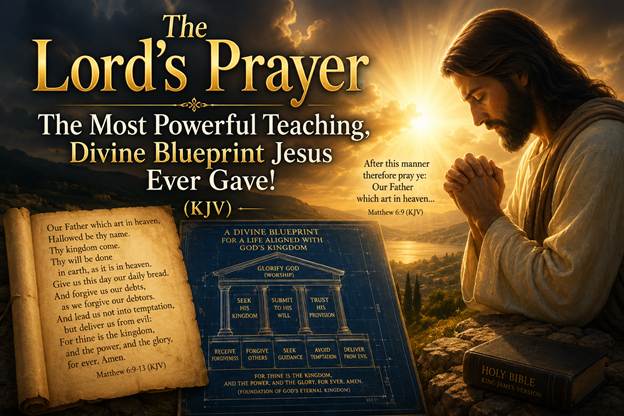
It teaches believers:
- To honor God
- To seek His will above their own
- To trust Him daily
- To forgive others
- To seek spiritual protection
- To live with eternal perspective
Most importantly, the prayer reveals the heart of true faith—not outward religion, but sincere dependence upon God.
Jesus was teaching that prayer is not about impressing others with many words. It is about genuine fellowship with the Father.
The Lord’s Prayer (Matthew 6:9–13 KJV)
“Our Father which art in heaven, Hallowed be thy name.
Thy kingdom come. Thy will be done in earth, as it is in heaven.
Give us this day our daily bread. And forgive us our debts, as we forgive our debtors.
And lead us not into temptation, but deliver us from evil:
For thine is the kingdom, and the power, and the glory, for ever. Amen.”
Discover more from The Gospel of Jesus Christ
Subscribe to get the latest posts sent to your email.

