May 14, 2026 | www.gospelofjesuschrist.blog | River Wilde
(The views expressed here are my personal beliefs, shaped by extensive study of the Gospel of Jesus Christ as recorded in the Bible. I have prayerfully sought God’s guidance throughout my research to remain focused on truth. I do not speak on behalf of any religious organization.)
In the summer of 1978, I was called to serve an LDS mission in Pittsburgh Pennsylvania. As a 19-year-old, I was excited to talk to people about Jesus Christ, and help those who were troubled in finding their way through life. What an opportunity to help people!
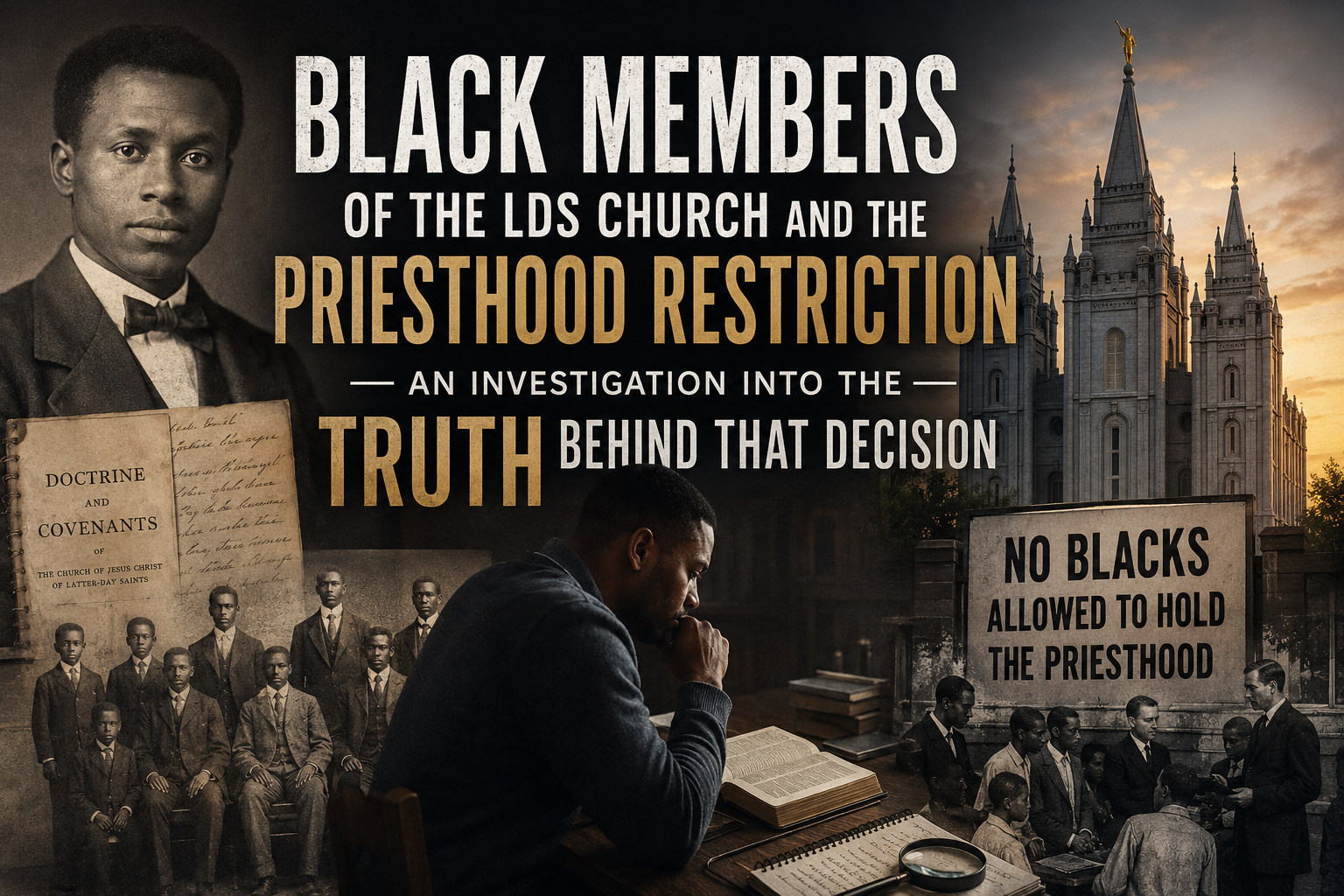
Just a few weeks into my mission, President Spencer Kimball announced what became known as Official Declaration 2, which ended the restriction that prevented Black men of African descent from being ordained to the priesthood in The Church of Jesus Christ of Latter-day Saints.
We as missionaries were excited that this blessing had finally been extended to all people, regardless of race.
As I began speaking with the people of Pittsburgh about this announcement, however, my excitement gradually gave way to confusion and a growing desire to understand why such a restriction had existed in the first place.
I reflected on the teachings I had received and also sought additional guidance from my mission president regarding the reasoning behind it. The explanations I received felt unclear, often differed from one another, and were delivered without much conviction. At the time, these were the four teachings that were commonly presented:
The “Curse of Cain” Theory
Some leaders taught that Black skin was connected to Cain in the Bible (Genesis 4), who killed Abel. They suggested descendants of Cain carried a divine mark or curse. This interpretation became common in 19th- and 20th-century LDS teachings, though the Bible itself never explicitly says Cain’s mark was black skin.
The “Curse of Ham” Theory
Others connected Black Africans to Ham or Canaan after Noah cursed Canaan in Genesis 9. This interpretation was also used historically by many non-LDS Christian groups to justify racial restrictions and slavery.
Premortal Existence Teachings
Some church leaders taught that Black people were “less valiant” in the premortal life before birth and therefore came to earth under restrictions. This idea was repeated in sermons and writings by some LDS authorities during the 20th century.
God’s Timing
Some leaders simply said the restriction existed because God had not yet revealed otherwise. President David O. McKay reportedly explored changing the policy but said he did not receive revelation to do so.
These explanations never sat well with me. When people asked why this restriction had ever been considered “doctrine” in the first place, I honestly told them that I did not have an answer. I was grateful, however, that the policy had changed, and I tried to focus on the hope and optimism surrounding this new announcement and the future it represented.
It has now been thirty-eight years since I had that experience. Within the church, the restriction preventing Black members from holding the priesthood seemed to quietly fade into the background. While the subject may have surfaced from time to time, I believe that for much of the general membership, it had largely been forgotten.
As I began researching for this paper, I wanted to examine this issue through the lens of how God views all of His children, as taught in the Bible. I also wanted to better understand the church’s current teachings regarding why this restriction was implemented in the first place. Were the explanations still the same as those taught in 1978? Or … had they changed over time?
Race and Our Relationship with God – KJV
From the beginning of Scripture, God reveals that all mankind comes from Him. Race, nationality, and outward appearance may divide people in the eyes of the world, but the Bible teaches that God looks far deeper than skin color or earthly heritage. According to the King James Version, every person is created by God, loved by God, and invited to come unto Him through Jesus Christ. The Lord measures mankind not by race, but by the condition of the heart.
In the book of Genesis, we are taught that all people descend from the same human family through Adam and Eve. This means that before God, humanity is one blood, one creation, and one race under Heaven.
“And hath made of one blood all nations of men for to dwell on all the face of the earth…” — Acts 17:26 (KJV)
This verse is powerful because it removes the idea that one race is spiritually superior to another. All nations, tribes, and peoples originated from the same Creator. God did not create separate categories of worth among mankind. Every person bears His image.
The Bible repeatedly teaches that God does not judge people based upon outward appearance. While mankind often focuses on race, status, wealth, or physical features, God examines the heart. In 1 Samuel 16:7, the Lord told Samuel:
“Look not on his countenance, or on the height of his stature… for the Lord seeth not as man seeth; for man looketh on the outward appearance, but the Lord looketh on the heart.” — 1 Samuel 16:7 (KJV)
This truth reaches beyond the selection of David as king. It reveals God’s nature toward all humanity. Men divide themselves by race and appearance, but God searches the inner man — faith, humility, repentance, love, and obedience.
Jesus Christ Himself demonstrated this throughout His earthly ministry. He ministered to Jews, Samaritans, Romans, the poor, the outcast, and strangers alike. In a time when deep racial and cultural divisions existed, Jesus crossed those barriers continually. He healed the servant of a Roman centurion, spoke publicly with a Samaritan woman, and taught through the parable of the Good Samaritan that compassion and righteousness matter more than ethnicity or tradition.
The Apostle Peter eventually came to understand this truth clearly after God corrected his own assumptions regarding different peoples. Peter declared:
“Of a truth I perceive that God is no respecter of persons:
But in every nation he that feareth him, and worketh righteousness, is accepted with him.” — Acts 10:34–35 (KJV)
Those words were revolutionary because they showed that salvation through Jesus Christ was not limited to one nationality or people group. God welcomes all who come to Him in faith. The ground at the foot of the cross is level.
The Apostle Paul reinforced this message in Galatians, teaching that earthly divisions lose their power in Christ:
“There is neither Jew nor Greek, there is neither bond nor free, there is neither male nor female: for ye are all one in Christ Jesus.” — Galatians 3:28 (KJV)
Paul was not saying that ethnic backgrounds disappear, but that they no longer determine a person’s standing before God. Salvation is offered equally to all through grace by faith in Jesus Christ.
One of the most beautiful pictures in Scripture is found in Revelation, where Heaven is described as being filled with believers from every nation and race worshipping together before God’s throne:
“After this I beheld, and, lo, a great multitude, which no man could number, of all nations, and kindreds, and people, and tongues, stood before the throne, and before the Lamb…” — Revelation 7:9 (KJV)
This is God’s final vision for redeemed humanity — not separated by hatred or prejudice, but united through Jesus Christ. Heaven will not be segregated by race. It will be filled with people from every background praising the same Savior.
The message of Scripture is clear: racism, hatred, pride, and prejudice come from the sinful nature of man, not from God. The Lord invites all people everywhere to repent, believe the gospel, and become part of His family through Christ. God sees beyond skin color. He sees the soul. And through Jesus Christ, He offers salvation equally to every person willing to come to Him in faith.
A Look into the Church’s Explanation Today –
The following information was taken directly from the church’s website:
“In 1852, President Brigham Young publicly announced that men of black African descent could no longer be ordained to the priesthood, though thereafter blacks continued to join the Church through baptism and receiving the gift of the Holy Ghost. Following the death of Brigham Young, subsequent Church presidents restricted blacks from receiving the temple endowment or being married in the temple. Over time, Church leaders and members advanced many theories to explain the priesthood and temple restrictions. None of these explanations is accepted today as the official doctrine of the Church.
Today, the Church disavows the theories advanced in the past that black skin is a sign of divine disfavor or curse, or that it reflects unrighteous actions in a premortal life; that mixed-race marriages are a sin; or that blacks or people of any other race or ethnicity are inferior in any way to anyone else. Church leaders today unequivocally condemn all racism, past and present, in any form.
The Church proclaims that redemption through Jesus Christ is available to the entire human family on the conditions God has prescribed. It affirms that God is “no respecter of persons” and emphatically declares that anyone who is righteous—regardless of race—is favored of Him.” (End of quote)
One of the greatest challenges for many members who study this issue deeply is reconciling the claim that the priesthood and temple restriction was rooted in revelation from God, while at the same time acknowledging that the explanations used to justify it are now rejected by the Church itself.
The Church’s current statement openly disavows the past teachings that black skin represented a curse, divine disfavor, premortal unfaithfulness, or inferiority. Modern Church leaders now condemn those teachings as false. This naturally leads many sincere believers to ask an unavoidable question: If the explanations once taught by prophets, apostles, manuals, and leaders for over a century are now rejected, then how could the restriction itself have truly originated from an unchanging and impartial God?
The Bible repeatedly teaches that God is “no respecter of persons” (Acts 10:34, KJV). Scripture consistently presents salvation, spiritual gifts, and access to God as being available to all people through faith, regardless of race or ethnicity. Galatians 3:28 declares, “There is neither Jew nor Greek… for ye are all one in Christ Jesus.”
The New Testament emphasis is on unity in Christ, not racial separation. Because of this, many people struggle to understand how a racial restriction preventing faithful black members from receiving priesthood ordinances and temple blessings could have reflected the heart of God, especially when the reasons once given for that restriction are now repudiated.
The issue becomes even more difficult when considering that Church leaders for generations spoke about these explanations with certainty and authority. They were not merely isolated opinions quietly held by a few members; many of these teachings were preached publicly in sermons, written in official publications, taught in classrooms, and repeated by Church leadership over decades.
Yet today, the Church distances itself from those teachings entirely. To many observers, this raises the possibility that the restriction itself may have been influenced more by the racial attitudes and cultural assumptions of the time than by divine revelation.
If a doctrine or practice truly comes from God, many would argue that its foundational reasoning should remain eternally true. God does not change His moral character according to social pressure or historical trends. Malachi 3:6 states,
“For I am the Lord, I change not.”
Therefore, when the explanations supporting a major policy are later declared false, it can lead people to conclude that the original restriction may not have been revelation at all, but rather a human misunderstanding attributed to God.
At the same time, the Church’s modern statement affirming the equal worth of all races aligns far more closely with the teachings of Jesus Christ found in the Bible. Christ ministered across ethnic boundaries, condemned prejudice, and invited all people to come unto Him. The message of the gospel is one of grace, reconciliation, and equality before God.
Many Christians therefore see the abandonment of these former racial teachings not as evidence that God changed His mind, but as evidence that human beings can sometimes misunderstand or misrepresent God’s will.
For many members and former members alike, this issue becomes deeply personal. It is not merely about history, but about trust, prophetic authority, and the nature of revelation itself. If leaders once confidently taught ideas now condemned as false, people naturally wrestle with how to discern what is truly from God versus what may originate from human tradition, cultural bias, or institutional pressure. These questions are difficult, emotional, and significant, especially for those who sincerely desire to follow Jesus Christ above all else.
Ultimately, many people conclude that the clearest standard must always be the character and teachings of Jesus Christ Himself. Any teaching that divides humanity by race, restricts spiritual blessings based on ethnicity, or contradicts the biblical declaration that God is no respecter of persons deserves careful examination in the light of scripture.
In closing, I am grateful for the Spirit-led understanding that came through researching this topic. As I studied both the scriptures and the historical teachings surrounding this issue, my heart was filled with sorrow that a church I once loved and trusted had, for so many years, placed discriminatory restrictions upon my brothers and sisters simply because of the color of their skin.
I can speak only for myself, but those policies never reflected my personal feelings, my love for others, or my understanding of the gospel of Jesus Christ. My hope is that this subject will encourage others to seek truth honestly, measure all teachings against the word of God, and remember that every person on this earth is equally precious in the sight of our Creator.
Discover more from The Gospel of Jesus Christ
Subscribe to get the latest posts sent to your email.


When I first heard the official announcement back in 1978, I was thrilled. That restriction always was on my mind before that. Now that I have been led back to the true Gospel of Jesus Christ as taught in KJV Bible, ( Thanks Father and Lord and others ) I recall scripture that says nothing will be hid, all will be revealed in these latter days. I suspect that more truths will be revealed and I hope more LDS people will see and understand how they have been deceived and come to the real truth and be in Christ.
LikeLiked by 1 person
Thanks for the comment. I am certainly trying to do all that I can to help my LDS friends see the deceptions of the church. =)
LikeLike