Nov 27, 2026 | www.GospelofJesusChrist.blog | River Wilde
(The views expressed in this article are my personal interpretations of the Bible, particularly concerning biblical prophecy and the end times. They have come to me through endless study of the scriptures, as well as frequent prayerful searching for TRUTH. They are offered for discussion, study, and personal reflection. I do not claim special revelation, nor do I speak on behalf of any church, denomination, religious organization, or its leaders. Readers are encouraged to study the Scriptures for themselves, seek God’s guidance through prayer, and draw their own conclusions.)
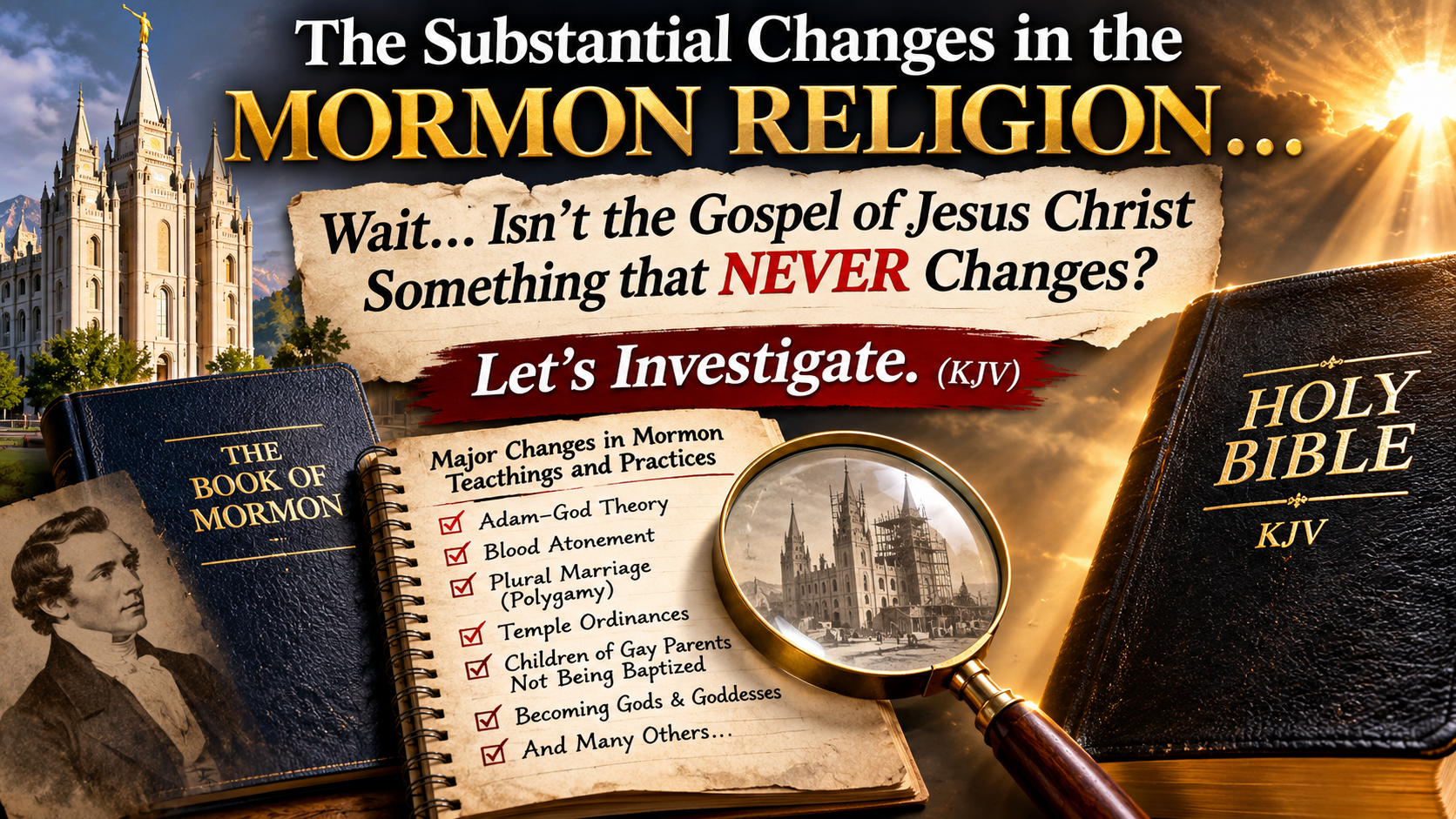
There have been numerous substantial changes in the teachings, ordinances, policies, and practices of The Church of Jesus Christ of Latter-day Saints since its organization in 1830.
Some of these changes are particularly significant because they concern the nature of God, the atonement of Jesus Christ, eternal marriage, priesthood authority, and ordinances associated with salvation and exaltation.
It is important to distinguish between teachings that were subsequently repudiated, doctrines that were modified, and Church policies that were reversed. The Church itself does not classify all of these changes as changes in eternal doctrine. I invite you to form your own conclusion regarding this.
Substantial Changes in Mormon Teachings and Practices
1. Plural Marriage (Polygamy)
- Original teaching: Plural marriage was instituted as a divinely authorized practice. Doctrine and Covenants 132 connects plural marriage with eternal covenants and exaltation.
- Change: In 1890, President Wilford Woodruff issued the Manifesto, which led to the discontinuation of plural marriage. Further restrictions followed in 1904.
- Present position: Members who enter into plural marriages are subject to Church discipline, although Doctrine and Covenants 132 remains part of LDS scripture.
2. Priesthood and Temple Restrictions Based on Race
- Original teaching and practice: Black members of African descent were restricted from receiving priesthood ordination (for men) and participating in certain temple ordinances. Some Church leaders offered theological explanations for these restrictions.
- Change: In June 1978, President Spencer W. Kimball announced a revelation removing racial restrictions.
- Present position: Worthy members may receive priesthood and temple blessings without racial restrictions.
Both of these major changes are documented in the Church’s own Official Declarations 1 and 2.
3. The Adam-God Theory
Originally taught by Brigham Young — 1852
Brigham Young taught that Adam was our Father and our God, and the father of our spirits.
Journal of Discourses, Volume 1, page 50.
Repudiated by President Spencer W. Kimball — 1976
During General Conference, President Kimball expressly denounced the Adam-God theory as false doctrine.
The Church today distinguishes Adam from God the Father. LDS defenders argue that Brigham Young’s teaching was never binding Church doctrine, despite his position as president of the Church.
4. Men and Women Becoming Gods and Goddesses — The Doctrine of Exaltation
One of the most significant teachings of the Mormon Church concerns the potential for men and women to become divine beings through exaltation.
Doctrine and Covenants 132:20 states:
Then shall they be gods, because they have no end.
Lorenzo Snow, the fifth president of the LDS Church, famously taught:
As man now is, God once was: As God now is, man may be.
This teaching has historically been an important part of LDS theology concerning eternal progression, celestial marriage and exaltation.
President Gordon B. Hinckley’s public statements in 1997
During an interview published in TIME Magazine on August 4, 1997, President Hinckley was asked whether the Church still taught that God the Father was once a man.
His response included the following:
“I don’t know that we teach it. I don’t know that we emphasize it. I haven’t heard it discussed for a long time in public discourse.”
He also expressed limited knowledge concerning the subject. Yet, this is mentioned every day in the temples of the church, and the basis of the religion. He totally denied such an “Important” doctrine of the church. Something, I feel, that he was too afraid of defending, and declaring openly.
In another interview, published in the San Francisco Chronicle on April 13, 1997, Hinckley described the question of God’s former existence as a matter of theology that was not well understood. However, he reaffirmed his belief in humanity’s potential for eternal progression.
The atonement of Jesus Christ could be categorized as something not well understood, but is certainly not something to be ashamed of, or have a lack of desire to support, regardless of the consequences.
The Church’s present position
The Church’s official Gospel Topics essay, Becoming Like God, acknowledges the historical teachings of Joseph Smith and Lorenzo Snow but explains that little has been revealed or is presently taught concerning God’s former existence.
The Church continues to teach that both men and women have the potential to attain exaltation and become like God.
This is therefore an example of a significant change in doctrinal emphasis and public presentation, rather than a complete abandonment of the doctrine of exaltation.
5. Blood Atonement
Originally taught during the 1850s
Brigham Young, Jedediah M. Grant and other Church leaders taught that certain sins were so serious that forgiveness required the shedding of the sinner’s own blood.
Present teaching: The Church rejects blood atonement and teaches that redemption comes through the atoning blood of Jesus Christ.
The Church acknowledges these historical teachings in its own Gospel Topics materials, while placing them in the context of the forceful religious preaching of that period.
This is particularly significant when compared with the biblical teaching:
1 John 1:7 (KJV)
“…the blood of Jesus Christ his Son cleanseth us from all sin.”
6. Changes to the Temple Ordinances
Numerous changes have been made to LDS temple ceremonies since Joseph Smith introduced the endowment in 1842.
| Approximate year | Change |
| 1920s | Removal of the oath of vengeance relating to the deaths of Joseph and Hyrum Smith. |
| 1923 | Temple garments permitted to be shortened. |
| 1950s | Introduction of filmed endowment instruction. |
| 1979 | Introduction of two-piece temple garments. |
| 1990 | Removal of symbolic penalties involving bodily harm. |
| 1990 | Removal of the Five Points of Fellowship at the veil. |
| 1990 | Removal of the portrayal of a Christian minister serving Satan. |
| 1990 | Modification of women’s covenant of obedience to their husbands. |
| 2005 | Changes to the administration of washing and anointing ceremonies. |
| 2019 | Further changes to women’s covenants, emphasizing their direct relationship with God, and not through their husbands. |
| 2024 | Additional shortening and revision of the endowment ceremony. |
The Church acknowledges repeated changes to temple procedures but maintains that the central covenants and underlying doctrines remain unchanged. As one inquires, if these things were so important once, why would they be changed or excluded? Historical accounts document additional details of these revisions.
7. Prohibiting the Baptism of Children of Same-Sex Couples
November 2015: The Church introduced a policy generally preventing children living with same-sex couples from receiving baptism until age 18, subject to specified conditions and approval. Same-sex marriage was also classified as apostasy for Church disciplinary purposes.
April 2019: The Church reversed these restrictions. Children could again be baptized with parental permission without special First Presidency approval. Same-sex marriage was no longer automatically classified as apostasy for disciplinary purposes.
The Church characterized this as a policy change rather than a change in its doctrine of marriage. Just for a moment, do you think that God would change His mind about doctrine in a matter of 4 years…or even EVER?
This reversal is particularly significant because baptism is regarded by the LDS Church as a necessary saving ordinance. Do you think that God would want a religion preventing baptism to anyone, due to the actions of their parents?
8. Racial Teachings Regarding the Premortal Existence
For generations, some LDS leaders taught that people of Black African descent:
- Were less valiant in the premortal existence.
- Were subject to a curse associated with Cain or Ham.
- Were consequently restricted from receiving certain spiritual blessings.
In 2013, the Church formally disavowed these explanations in its Gospel Topics essay Race and the Priesthood.
These explanations, once promoted by prominent Church leaders, are no longer accepted as Church doctrine.
So, which is it? Are they cursed or not? Are they less valiant or not? Are they to be restricted of receiving certain spiritual blessings or not?
9. The Nature of God — Removal of the Lectures on Faith
In 1835, the Lectures on Faith were included in the Doctrine and Covenants, constituting its original doctrinal portion.
Lecture Five described God the Father as a personage of spirit. Later, Joseph Smith taught that God the Father possessed a tangible body of flesh and bones (Doctrine and Covenants 130:22).
In 1921, the Lectures on Faith were removed from the Doctrine and Covenants. Church leaders acknowledged concerns regarding the apparent contradiction about the nature of God, while maintaining that the lectures had not been formally accepted as revelations.
God is a SPIRIT… wait… God has a body of flesh and bones. This is a substantial doctrine that took the church 86 years to conclude in their own scriptures.
10. The Law of Adoption — Eternal Family Sealings
Original practice: Members could be sealed in the temple to prominent priesthood leaders rather than their own biological parents.
This created extensive networks of spiritually adopted families.
1894 change: President Wilford Woodruff redirected the practice toward sealing individuals to their own ancestors, including deceased parents who had never joined the Church.
11. The Word of Wisdom
1833: Doctrine and Covenants 89:2 specifically stated:
“Not by commandment or constraint.”
1851: Brigham Young called upon members to observe the Word of Wisdom as a binding commitment, yet he himself did not obey this “commandment.”
1921: Under President Heber J. Grant, observance became a standard requirement for receiving a temple recommend.
What began as religious counsel eventually became a requirement for access to ordinances associated with exaltation.
12. Rebaptism for the Remission of Sins and Renewal of Covenants
Early Church members were frequently rebaptized for reasons including repentance, renewal of covenants, preparation for temple ordinances and physical healing.
Beginning in the 1890s, Church leaders discontinued or restricted these practices, with remaining forms phased out by the 1920s.
Today, members are taught to repent and renew their baptismal covenants through the sacrament rather than through repeated baptisms.
13. Changes to the Book of Mormon Regarding the Nature of God
Several significant changes were made to the 1837 edition of the Book of Mormon.
| Scripture | Original 1830 wording | Revised wording |
| 1 Nephi 11:18 | Mother of God | Mother of the Son of God |
| 1 Nephi 11:21 | The Eternal Father | The Son of the Eternal Father |
| 1 Nephi 11:32 | The everlasting God | The Son of the everlasting God |
| 1 Nephi 13:40 | The Eternal Father | The Son of the Eternal Father |
These changes are acknowledged by the Church, which considers them clarifications. They are nevertheless significant because they concern the identity and nature of Jesus Christ, and are talking about two different entities.
14. The Ancestry of Native Americans
The 1981 introduction to the Book of Mormon identified the Lamanites as the principal ancestors of American Indians.
Beginning with an updated edition in 2006, this was changed to indicate that the Lamanites were among the ancestors of American Indians. This was very notable, as time and historical evidence became easily accessible, and disproved the original teachings.
The Church acknowledges this change in its Gospel Topics essay concerning DNA studies.
15. The Translation of the Book of Abraham
The Book of Abraham was historically presented as a translation of Egyptian papyri acquired by Joseph Smith.
The Church now acknowledges that surviving fragments contain Egyptian funerary texts and that the characters do not correspond to the text of the Book of Abraham. (oops!)
The Church allows for several explanations, including the possibility that the papyri served as a catalyst for revelation rather than being the literal source of the text. It continues to accept the Book of Abraham as scripture. Someone’s funeral announcement is Mormon scripture. What an honor.
16. The Translation of the Book of Mormon
Many Church members grew up with illustrations depicting Joseph Smith studying the gold plates directly while translating them.
More recent official Church materials acknowledge that Joseph Smith used a seer stone placed inside a hat to dictate the Book of Mormon. He wasn’t translating anything.
The Gold Plates were not even in the room most of the time that he was translating, and if so they were “covered up.” This even eliminates the “necessity” of the golden plates all together. Something that the church uses as an introduction to church doctrine. This new discovery was incredibly damaging for the church, for it exposed the deception that the church was portraying.
17. The Sacrament — Wine Replaced with Water
The early LDS Church used wine when administering the sacrament, as prescribed in its early scriptures.
Over time, wine was replaced with water. The Church bases this authorization on Doctrine and Covenants 27, which was received in 1830.
Jesus Christ actually used wine in His last supper. Is this important? Why was it changed? Could it be that this went against the new “commandment” of the word of Wisdom? Did the word of wisdom come from God? Why would God tell people that it was sinful to do the same thing that Jesus Christ had done while He was on the earth?
18. The Original Declaration Regarding Marriage
The 1835 edition of the Doctrine and Covenants contained a declaration on marriage affirming monogamy.
In 1876, this declaration was omitted, and the revelation concerning eternal and plural marriage, now known as Section 132, was added.
This is particularly noteworthy because the Church’s published scriptural position regarding marriage changed before plural marriage was eventually discontinued.
19. Additional Changes in Religious Policies and Practices
There have also been numerous changes that are administrative or procedural in nature.
| Subject | Previous practice | Revised practice |
| Temple marriage | One-year waiting period following civil marriage in many countries | Waiting period removed in 2019 |
| Missionary age | Men 19; women 21 | Lowered to 18 and 19 respectively in 2012 |
| Women witnessing ordinances | Restricted to male witnesses | Women authorized in 2019 |
| Baptisms for the dead | More restrictive eligibility for officiators | Young men ordained as priests authorized in 2017 |
| Sunday worship | Three-hour meeting schedule | Two-hour schedule beginning in 2019 |
| Home and visiting teaching | Formal visitation programs | Replaced by ministering in 2018 |
| Fast day | First Thursday of the month | First Sunday beginning in 1896 |
| Mormon identity | Official promotion of the Mormon nickname, including the I’m a Mormon campaign | Emphasis against using the nickname beginning in 2018 |
These administrative changes should not necessarily be equated with changes concerning salvation or the nature of God.
Comparing These Changes with the Bible (KJV)
The more significant theological question is not whether a religious organization can change its administrative procedures. It is whether teachings concerning God, salvation, forgiveness and eternal life can be proclaimed by one prophet and subsequently rejected by another.
Malachi 3:6 — God does not change
For I am the LORD, I change not; therefore ye sons of Jacob are not consumed.
Hebrews 13:8 — Jesus Christ does not change
Jesus Christ the same yesterday, and to day, and for ever.
Galatians 1:8 — A warning against altering the Gospel
But though we, or an angel from heaven, preach any other gospel unto you than that which we have preached unto you, let him be accursed.
Isaiah 40:8 — The permanence of God’s Word
The grass withereth, the flower fadeth: but the word of our God shall stand for ever.
A conclusion worth considering
If a religious leader teaches something concerning the very nature of God, the atonement of Jesus Christ, or the requirements for eternal life, and a subsequent religious leader rejects that teaching, it raises a legitimate and important question: How can members confidently distinguish divine revelation from the personal opinions of their religious leaders?
This is not an attack upon the sincere and faithful members of the Mormon Church. Rather, it is an invitation to examine religious teachings carefully against the Word of God found in the New Testament.
Our eternal destiny is far too important to place our confidence in the teachings of any man without examining them against the teachings of Jesus Christ Himself.
1 Thessalonians 5:21 (KJV)
Prove all things; hold fast that which is good.
Discover more from The Gospel of Jesus Christ
Subscribe to get the latest posts sent to your email.

