November 3, 2026 | www.GospelofJesusChrist.blog | River Wilde
Introduction — One Man, Two Possible Outcomes: Peace or War!
I cannot keep up with the events of the day, regarding peace in the Middle East and Untied States. They change daily, sometimes even by the hour.
Regardless of your feelings toward President Trump, I think that we can all agree that he approaches leadership in his very own style…Good or bad, it is different, often extreme, and sometimes even unpredictable.
Something extraordinary is happening in the Middle East, and the events of the past 24 hours have made the situation even more chaotic.
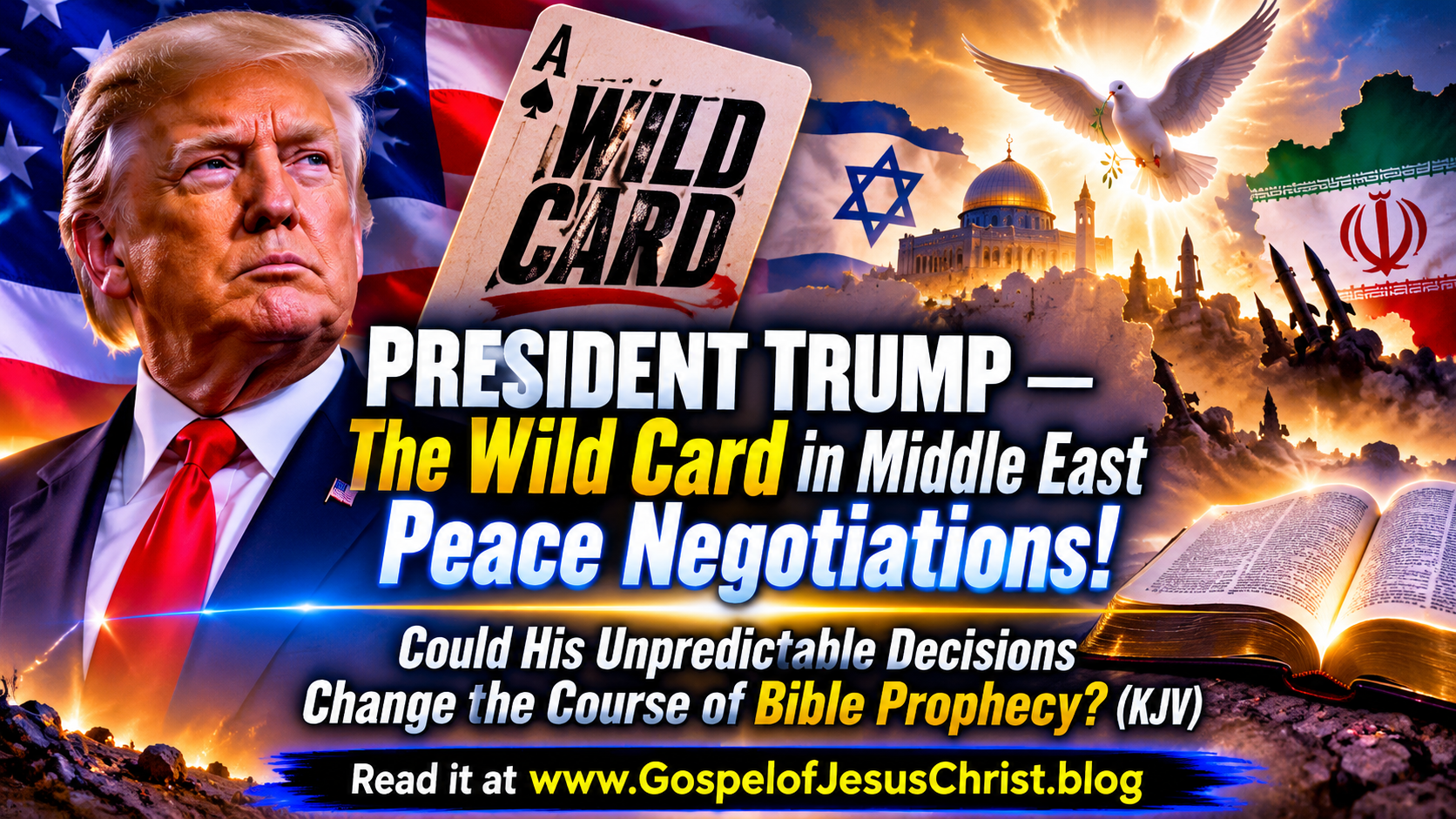
President Donald Trump has placed himself at the center of one of the most dangerous diplomatic confrontations in the world.
On one hand, he is expressing optimism that a peace agreement with Iran may be possible. On the other hand, his administration is implementing additional military last night, declaring it to be a defensive move, retaliation for strikes against the US.
Could President Trump be the wild card who unexpectedly brings peace to the Middle East? Or could his unpredictable decisions ignite a much larger conflict? (I’d like to hear your comments, because it is a surprise for me each day!)
Even more importantly, could the outcome help establish the conditions described in Bible prophecy?
Let’s investigate the latest developments, examine Trump’s unusual negotiating approach, and compare these events with what the King James Bible actually teaches.
1. American Military Strikes Iran While Peace Negotiations Continue
On November 3, reports confirmed that American forces had launched limited military strikes against Iranian targets on Qeshm Island, near the Strait of Hormuz.
American officials described the operation as defensive, responding to Iranian military activity threatening U.S. aircraft.
What makes this development especially remarkable is its timing.
Just hours earlier, President Trump had expressed optimism about reaching an agreement with Iran.
Meanwhile, Qatar has been working to bring the United States and Iran closer to a negotiated settlement.
Yet the two nations remain divided over major issues, including sanctions, military operations, and access to the Strait of Hormuz.
Think about this: While diplomats are discussing peace, military forces are still exchanging threats and carrying out operations.
This is precisely why President Trump has become such an unpredictable factor in these negotiations.
2. Why Is President Trump Such a Wild Card?
President Trump has demonstrated a negotiating style that is considerably different from traditional diplomacy.
Rather than relying exclusively on private discussions and gradual compromises, he frequently combines public statements, economic pressure, military threats, and sudden changes in negotiating positions.
Consider what we are witnessing:
- He expresses optimism about achieving peace.
- He warns Iran that additional military attacks remain possible.
- He allows diplomatic negotiations to continue while maintaining military pressure.
- He leaves both allies and adversaries uncertain about his next decision.
Some observers believe this unpredictability gives Trump negotiating leverage because opposing leaders cannot easily anticipate his actions.
Others believe it increases the danger of miscalculation, potentially turning a limited confrontation into a much larger war.
Both possibilities deserve serious consideration.
The remarkable question is whether Trump’s unpredictability might ultimately produce a peace agreement that conventional diplomacy could not achieve.
3. Could Military Pressure Actually Lead to Peace?
This may sound contradictory, but history demonstrates that military pressure and diplomatic negotiations sometimes occur simultaneously.
A nation facing overwhelming military threats may become more willing to negotiate.
However, military pressure can also have the opposite effect, causing a threatened nation to retaliate rather than compromise.
President Trump appears willing to use both approaches.
Iran, meanwhile, has indicated that it is prepared for diplomacy but will respond to further attacks.
The situation creates three possible outcomes.
Possibility One — A Negotiated Peace
Trump’s military pressure persuades Iran to accept an agreement, reducing the immediate threat of a wider regional conflict.
Possibility Two — A Much Larger War
Iran retaliates against American or allied targets, triggering additional military action and potentially drawing other nations into the conflict.
Possibility Three — A Temporary Agreement That Eventually Leads to Greater Regional Security
An initial agreement between the United States and Iran could become one part of a broader diplomatic effort involving Israel and neighboring nations.
None of these outcomes is guaranteed.
But the third possibility raises an especially interesting question concerning Bible prophecy.
4. Bible Prophecy Describes Israel Dwelling Safely Before the Gog-Magog Invasion
Let’s turn to Ezekiel.
Ezekiel 38:8 (KJV)
After many days thou shalt be visited: in the latter years thou shalt come into the land that is brought back from the sword, and is gathered out of many people, against the mountains of Israel, which have been always waste: but it is brought forth out of the nations, and they shall dwell safely all of them.
Notice those final words:
“And they shall dwell safely all of them.”
Now consider Ezekiel 38:11 (KJV):
And thou shalt say, I will go up to the land of unwalled villages; I will go to them that are at rest, that dwell safely, all of them dwelling without walls, and having neither bars nor gates,
This prophecy describes Israel experiencing a condition of security before the invasion led by Gog.
Under a common futurist interpretation, this is an important condition that must exist before the future Gog-Magog invasion.
But here is the question:
How does Israel move from its present environment of military threats and regional hostility into the security described by Ezekiel?
Could diplomatic agreements help create that environment?
Possibly.
Could President Trump’s negotiations contribute to that process?
Again, possibly.
However, Scripture does not identify President Trump or any modern American president as the person who establishes this condition.
We must be careful not to confuse an interesting possibility with a confirmed prophetic fulfillment.
5. Could a Peace Agreement Come Before the Gog-Magog War?
This brings us to something we have been investigating in our previous Bible prophecy studies.
Consider the following possible sequence of events:
First: Regional conflicts and diplomatic pressure eventually produce a period of improved security for Israel.
Second: Israel experiences the conditions described in Ezekiel 38:8–11.
Third: The Gog-Magog invasion occurs, and God supernaturally intervenes to defeat the invading armies.
Fourth: The Rapture of the Church occurs, if this proposed sequence places it after the Gog-Magog conflict.
Fifth: The future ruler commonly identified as the Antichrist confirms the covenant described in Daniel 9:27.
This is one possible prophetic interpretation, not a timeline explicitly established by Scripture.
In particular, the Bible does not directly tell us whether the Rapture occurs before or after the Gog-Magog invasion.
But there is an important distinction we should understand.
A modern peace agreement involving Iran is not automatically the seven-year covenant described in Daniel 9:27.
These could be entirely separate events.
And that distinction may be essential to understanding how the prophetic pieces fit together.
6. The Seven-Year Covenant — Could It Come Later?
Daniel 9:27 (KJV)
And he shall confirm the covenant with many for one week: and in the midst of the week he shall cause the sacrifice and the oblation to cease, and for the overspreading of abominations he shall make it desolate, even until the consummation, and that determined shall be poured upon the desolate.
Many pre-Tribulation prophecy teachers understand the prophetic week as a seven-year period and associate this covenant with the future Antichrist.
Under that interpretation, the covenant is connected to the final seven years preceding Christ’s return.
But consider something important.
The Bible does not explicitly state that every peace agreement involving Israel must be this particular covenant.
There could be other diplomatic agreements before that time.
Therefore, if President Trump successfully negotiates peace involving Iran, Israel, or other Middle Eastern nations, that agreement would not automatically establish the beginning of the Tribulation.
We would need to examine its actual terms and compare them carefully with Scripture.
7. When They Say, Peace and Safety!
Now let’s examine a particularly sobering passage.
1 Thessalonians 5:3 (KJV)
For when they shall say, Peace and safety; then sudden destruction cometh upon them, as travail upon a woman with child; and they shall not escape.
This passage warns of sudden destruction associated with declarations of peace and safety.
Imagine a future situation in which Middle Eastern leaders announce that a major conflict has ended.
The world celebrates.
Financial markets respond positively.
Governments congratulate one another.
People begin believing that lasting security has finally arrived.
Could such circumstances resemble the atmosphere described by Paul?
They could.
However, the passage does not specifically identify a U.S.-Iran agreement, President Trump, or the Gog-Magog invasion.
Its immediate context concerns the Day of the Lord.
Nevertheless, the warning is important:
Human declarations of peace are not guarantees of lasting security.
This is why Christians should place their ultimate confidence in Jesus Christ rather than any political agreement.
8. Could God Use an Unpredictable World Leader to Accomplish His Purposes?
This is perhaps the most fascinating biblical question in our discussion.
Throughout Scripture, God demonstrates His sovereignty over kings, rulers, and nations.
Consider Proverbs 21:1 (KJV):
The king’s heart is in the hand of the LORD, as the rivers of water: he turneth it whithersoever he will.
And Daniel 2:21 (KJV):
And he changeth the times and the seasons: he removeth kings, and setteth up kings: he giveth wisdom unto the wise, and knowledge to them that know understanding:
These Scriptures teach that earthly rulers do not operate outside God’s sovereignty.
But does that mean President Trump is knowingly fulfilling a specific end-times prophecy?
No such conclusion can be established from Scripture.
God’s sovereignty over history does not give us permission to assign prophetic identities to contemporary leaders without biblical evidence.
Nevertheless, Christians can recognize that even unexpected political developments remain within God’s knowledge.
No person, regardless of power has the ability to change Bible Prophecy regarding the end times. Weather they know it or not, all of their actions are known by God, and will not fall outside of His plan.
I’d like to interject a thought here for you to consider. There are people, living right now, who feel that they have a chance in changing Bible prophecy. There are even those, who have studied bible prophecy, and are specifically trying to CHANGE, or survive what is coming, using the powers of this world.
To me, a great example is that those who are building “Bunkers” or fortifying structures, thinking that they will protect them from the end time prophecies.
Revelation 6:15–17 (KJV)
“And the kings of the earth, and the great men, and the rich men, and the chief captains, and the mighty men, and every bondman, and every free man, hid themselves in the dens and in the rocks of the mountains;”
“And said to the mountains and rocks, Fall on us, and hide us from the face of him that sitteth on the throne, and from the wrath of the Lamb:”
“For the great day of his wrath is come; and who shall be able to stand?”
Another Important Prophecy — Isaiah 2:19 (KJV)
“And they shall go into the holes of the rocks, and into the caves of the earth, for fear of the LORD, and for the glory of his majesty, when he ariseth to shake terribly the earth.”
What Does This Mean in End-Times Prophecy?
These scriptures describe a terrifying time when people of every social class, including powerful world leaders, attempt to hide from God’s judgment.
I think about even leaders of a church who have set aside HUNDREDS of BILLIONS of dollars, thinking that riches can protect them from the Power of God; or fortifying a temple will keep them safe from what is coming. Satan has deceived these men, in my opinion. Why would Christ’s church need money? Money is associated with worldly power, NOT divine.
Those who are “in Christ” already know that they will be lifted up to meet the Lord in the air, prior to the tribulation beginning. MY Faith… YOUR Faith is in God, and in HIS PLAN for those who are in Christ. We do not even need to consider preparing to defend ourselves against HIM. He is our rescuer. He is our King. And His prophetic promises are COMPLETE in caring for His children.
We should not even fear the enemy, for we are sealed with the Holy Spirit and belong to GOD! Our future has ALREADY been determined, to live with God forever in a new Heaven that He will create for us.
Even death at the hands of our enemy, is simply the turning of a page, that gets us directly into our next chapter of eternity. Many of you reading this writing are fully aware of what is waiting for us, and CANNOT wait to get there. Death by the hands of others only gets us there quicker. =)
8. What Should Christians Watch for Next?
With the midterm elections happening today, I would have to say that we should be extremely watchful for the next few days. “Watchful”, not worried.
I have spent the past few days, studying Donald Trump, in order to understand his behavior better.
Donald Trump’s upbringing in a wealthy, highly competitive environment, under a father who reportedly emphasized toughness, winning, and success, may have contributed to his confrontational personality and leadership style.
Critics argue that Trump frequently demonstrates a lack of compassion and empathy, placing personal loyalty, political victories, and his own reputation ahead of the needs of others. His reluctance to acknowledge defeat, apologize, or concede a negotiation can create the impression of a leader who views compromise as weakness rather than an opportunity for peace.
Other factors raise serious questions about what influences Trump’s political decisions today. At 80 years old, concerns about his health, the pressures of aging, and the psychological impact of surviving assassination attempts deserve consideration, although their actual influence on his judgment cannot be established without evidence.
His determination to avoid appearing weak or losing a negotiation may encourage increasingly unpredictable decisions, particularly during international crises.
Perhaps the most troubling question is whether Trump has become so personally invested in his own political survival and legacy that he might be willing to accept extraordinary risks for the country and the world rather than acknowledge defeat. That is a concern worth examining, not a proven conclusion about his intentions or state of mind.
9. Our Greatest Hope Is Not President Trump — It Is Jesus Christ!
Regardless of whether someone supports President Trump or disagrees with his decisions, one truth remains unchanged.
No president, prime minister, military commander, or international organization can provide the eternal peace that Jesus Christ offers.
Consider John 14:27 (KJV):
Peace I leave with you, my peace I give unto you: not as the world giveth, give I unto you. Let not your heart be troubled, neither let it be afraid.
What a wonderful promise!
The peace offered by the world depends upon agreements, negotiations, military strength, and the willingness of nations to honor their commitments.
But the peace Jesus Christ offers reaches far beyond political circumstances.
And most importantly, He offers eternal life to everyone who places their faith in Him.
John 3:16 (KJV)
For God so loved the world, that he gave his only begotten Son, that whosoever believeth in him should not perish, but have everlasting life.
Our responsibility as Christians is not to live in fear of tomorrow.
It is to remain faithful to Jesus Christ, share His Gospel, pray for peace, and remain spiritually prepared for His return.
But we do know that God’s Word encourages us to remain watchful.
Matthew 24:42 (KJV)
Watch therefore: for ye know not what hour your Lord doth come.
I boldly proclaim “AMEN” to that scripture teaching. We do not know when Jesus will return for His Bride…But, what we do know is that HE WILL!
Until next time, may God bless you, strengthen your faith, and fill your heart with the peace that only Jesus Christ can provide.
Keep watching. Keep studying. And above all, keep your faith in Jesus Christ!
Discover more from The Gospel of Jesus Christ
Subscribe to get the latest posts sent to your email.

