Sept 13, 2026 | www.GospelofJesusChrist.blog | River Wilde
For many Christians who study Bible prophecy, the Feast of Trumpets has long received special attention as a possible picture of the Rapture. The reason is understandable. The New Testament tells us that the Lord will descend from heaven “with the trump of God” and that believers will be “caught up together” to meet Him (1 Thessalonians 4:16–17).
Paul similarly tells us that “the trumpet shall sound” when the dead are raised and living believers are changed (1 Corinthians 15:51–52). But what happens if we broaden our view beyond the Feast of Trumpets itself?
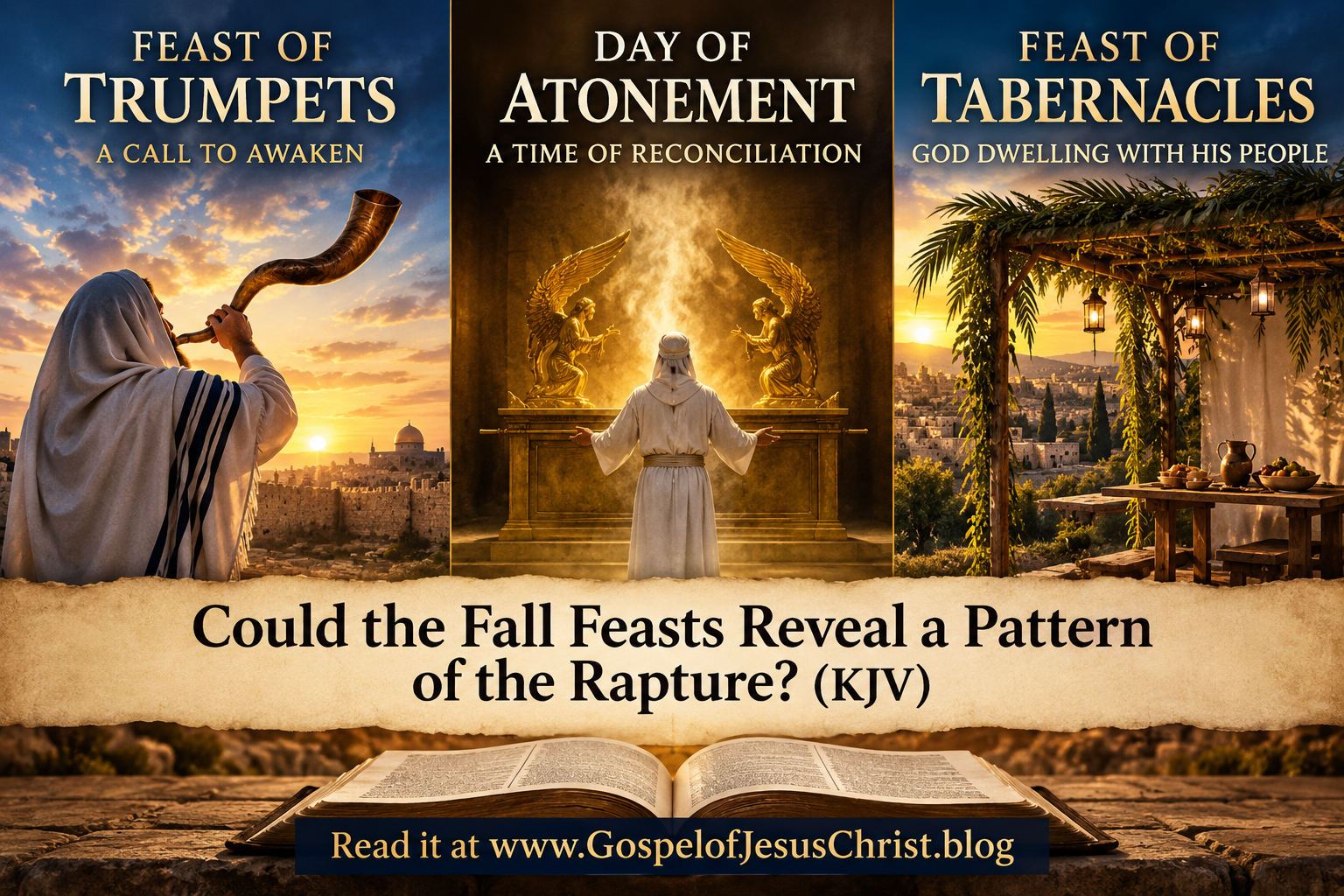
There are actually three major appointed observances clustered together in the seventh biblical month: Trumpets, the Day of Atonement, and Tabernacles. When examined together, they present an extraordinary progression of trumpet, atonement, liberty, gathering, and ultimately dwelling with God.
Before going further, however, an important distinction must be made. The Bible never states that the Rapture will occur on the Feast of Trumpets, the Day of Atonement, Jubilee, or the Feast of Tabernacles. However, this does not mean that we can not study them with that possibility in mind.
These feasts contain remarkable prophetic themes, but similarities are not the same thing as a revealed date. Jesus told us, “Watch therefore, for ye know neither the day nor the hour wherein the Son of man cometh” (Matthew 25:13). Therefore, rather than attempting to predict another date, let us simply investigate what God placed within these appointed times.
THE FEAST OF TRUMPETS — THE SOUNDING BEGINS
Begins sunset Sept. 11, 2026; 1 Tishrei is Sept. 12, 2026.
The first of these fall observances occurs on the first day of the seventh month. God commanded Israel:
“In the seventh month, in the first day of the month, shall ye have a sabbath, a memorial of blowing of trumpets, an holy convocation.”
— Leviticus 23:24
The trumpet immediately catches the attention of anyone studying the Rapture because Paul uses remarkably similar imagery:
“For the Lord himself shall descend from heaven with a shout, with the voice of the archangel, and with the trump of God: and the dead in Christ shall rise first.”
— 1 Thessalonians 4:16
Paul provides another description in 1 Corinthians:
“In a moment, in the twinkling of an eye, at the last trump: for the trumpet shall sound, and the dead shall be raised incorruptible, and we shall be changed.”
— 1 Corinthians 15:52
This explains why generations of prophecy students have been fascinated with Trumpets. The similarity is genuine. Both contain trumpet imagery, assembly and God’s people being summoned.
Paul tells us there will be a trump of God. Connecting that trumpet specifically to the feast is a reasonable interpretation—but not an explicit identification made by Scripture.
And perhaps there is something important to learn from that distinction.
TEN DAYS LATER — THE DAY OF ATONEMENT
Begins sunset Sept. 20, 2026 and ends after nightfall Sept. 21, 2026.
The seventh month does not end with Trumpets. Only days later comes one of Israel’s most solemn appointed days:
“Also on the tenth day of this seventh month there shall be a day of atonement.”
— Leviticus 23:27
The Day of Atonement therefore occurs on the tenth day of the same month in which Trumpets occurs on the first.
Its biblical timing is also very specific:
“From even unto even, shall ye celebrate your sabbath.”
— Leviticus 23:32
The observance therefore extends from evening until evening.
For Christians, atonement immediately points us toward Jesus Christ. Hebrews tells us:
“By the which will we are sanctified through the offering of the body of Jesus Christ once for all.”
— Hebrews 10:10
Christ’s sacrifice does not need to be repeated. Our salvation does not depend upon reaching a particular feast day. Jesus accomplished the work necessary for our redemption at Calvary.
Yet the Day of Atonement becomes even more interesting when we turn from Leviticus 23 to Leviticus 25.
THE SURPRISING JUBILEE CONNECTION
God commanded Israel to count seven sabbaths of years—seven times seven years:
“And thou shalt number seven sabbaths of years unto thee, seven times seven years…”
— Leviticus 25:8
Following those forty-nine years came Jubilee. And notice carefully when its trumpet was commanded to sound:
“Then shalt thou cause the trumpet of the jubilee to sound on the tenth day of the seventh month, in the day of atonement shall ye make the trumpet sound throughout all your land.”
— Leviticus 25:9
This is an important distinction.
The Jubilee trumpet was not commanded to sound on the Feast of Trumpets.
It was commanded to sound on the Day of Atonement.
And what did this trumpet announce?
“And ye shall hallow the fiftieth year, and proclaim liberty throughout all the land unto all the inhabitants thereof…”
— Leviticus 25:10
Now the imagery becomes fascinating.
A trumpet sounds. Liberty is proclaimed. Bondage ends. Possessions are restored. People return to their families.
That naturally reminds a Christian prophecy student of Paul’s description of our ultimate release from mortality:
“For this corruptible must put on incorruption, and this mortal must put on immortality.”
— 1 Corinthians 15:53
Again, Scripture does not say the Jubilee trumpet is the Rapture trumpet. We must not make that leap and call it established doctrine. Nevertheless, the parallel deserves appreciation. Jubilee provides one of Scripture’s most beautiful pictures of release, restoration and return.
THEN COMES THE FEAST OF TABERNACLES
Begins sunset Sept. 25, 2026 and continues through nightfall Oct. 2, 2026.
Five days after the Day of Atonement begins another great feast:
“The fifteenth day of this seventh month shall be the feast of tabernacles for seven days unto the LORD.”
— Leviticus 23:34
Israel was commanded to dwell in booths during this feast as a remembrance of God’s care for them when He brought them out of Egypt (Leviticus 23:42–43).
But there is a larger biblical theme contained in the word tabernacle: dwelling.
And when we reach the final chapters of Revelation, we encounter an extraordinary statement:
“Behold, the tabernacle of God is with men, and he will dwell with them, and they shall be his people, and God himself shall be with them, and be their God.”
— Revelation 21:3
That is ultimately where God’s story is going.
Not merely toward escaping Earth.
Not merely toward surviving judgment.
Not merely toward hearing a trumpet.
But toward being with God.
That is also precisely where Paul’s Rapture passage ultimately takes us:
“And so shall we ever be with the Lord.”
— 1 Thessalonians 4:17
Perhaps that is the most beautiful connection of all.
TRUMPETS → ATONEMENT → TABERNACLES
When these three appointed times are viewed together, an intriguing biblical progression emerges:
TRUMPETS
A trumpet sounds. God’s people are summoned.
↓
ATONEMENT
Sin and reconciliation with God stand at the center.
↓
JUBILEE TRUMPET — when an actual Jubilee occurred
Liberty is proclaimed. Bondage ends. Restoration and return begin.
↓
TABERNACLES
God dwells among His people.
Now compare those themes with the Christian hope:
TRUMP OF GOD
“The trump of God.”
— 1 Thessalonians 4:16
↓
CHRIST’S ATONEMENT
“Once for all.”
— Hebrews 10:10
↓
RELEASE FROM MORTALITY
“This mortal must put on immortality.”
— 1 Corinthians 15:53
↓
GATHERED TO CHRIST
“Caught up together with them in the clouds.”
— 1 Thessalonians 4:17
↓
DWELLING WITH HIM
“So shall we ever be with the Lord.”
— 1 Thessalonians 4:17
The parallels are remarkable. Can you see them? Can you see the entire picture of this month of Jewish holidays?
WHAT ABOUT THE RAPTURE?
Could the Rapture occur during one of these appointed times? Again, it is very reasonable to make this connection here. Certainly nothing prevents God from doing so.
Could Trumpets foreshadow the trumpet associated with Christ’s coming? It is an interesting possibility.
Could Jubilee’s trumpet and proclamation of liberty provide a picture of believers being released from mortality and corruption? Absolutely.
Could Tabernacles ultimately point toward God’s great purpose of dwelling forever with His redeemed people? Scripture itself gives us powerful language supporting that theme.
But can we conclude from these things that the Rapture must occur on one of these dates?
No.
That final step is precisely where we need to be careful.
After all, Jesus’ parable of the ten virgins contains something prophecy watchers should never overlook:
“While the bridegroom tarried, they all slumbered and slept.”
— Matthew 25:5
The Bridegroom did not arrive when they apparently expected Him.
Then suddenly:
“And at midnight there was a cry made, Behold, the bridegroom cometh; go ye out to meet him.”
— Matthew 25:6
The wise virgins were not distinguished because they successfully calculated the Bridegroom’s arrival.
They were distinguished because they were ready when He finally came.
Perhaps that is particularly important after another Feast of Trumpets has passed without the event many Christians hoped would occur.
We should not necessarily respond by immediately moving our expectation from Trumpets to the Day of Atonement, from Atonement to Tabernacles, and then to another possible date. That could transform beautiful biblical prophecy into an exhausting sequence of expectations and disappointments.
Instead, perhaps we should allow these feasts to accomplish what Scripture unquestionably allows them to accomplish: teach us about God’s plan.
Trumpets reminds us that a trumpet really will sound.
Atonement reminds us that our salvation rests entirely upon what Jesus Christ accomplished for us.
Jubilee reminds us that God is a God of liberty, restoration and return.
Tabernacles reminds us of the magnificent destination toward which redemption is moving:
God dwelling with His people.
And the Rapture promise brings those hopes together beautifully:
“For the Lord himself shall descend from heaven with a shout, with the voice of the archangel, and with the trump of God…”
And then:
“Then we which are alive and remain shall be caught up together with them in the clouds, to meet the Lord in the air: and so shall we ever be with the Lord.”
— 1 Thessalonians 4:16–17
Maybe that final sentence deserves more of our attention than any date on the calendar.
The great promise of the Rapture isn’t ultimately when we leave.
It is Who we will finally be with.
“Wherefore comfort one another with these words.”
— 1 Thessalonians 4:18
I feel strongly that Jesus is in the “tarrying” portion of His example of coming for the Bridegroom.
While the bridegroom tarried, they all slumbered and slept.” — Matthew 25:5
The tarrying is deliberately part of the story. So, the question becomes: what does the delay accomplish?
First, the tarrying reveals whether our faith is ultimately in Christ or in the expected timing of Christ. The virgins apparently expected the bridegroom earlier. Yet the distinguishing characteristic of the wise wasn’t that they knew when he would arrive. It was that they had oil when he finally did.
“But the wise took oil in their vessels with their lamps.” — Matthew 25:4
The delay exposed something that an immediate arrival wouldn’t have exposed: who remained prepared when expectation turned into waiting.
Second, the delay demonstrates God’s longsuffering toward people who have not yet repented. Peter addresses the apparent delay of Christ directly:
“The Lord is not slack concerning his promise, as some men count slackness; but is longsuffering to us-ward, not willing that any should perish, but that all should come to repentance.” — 2 Peter 3:9
Third, tarrying develops patience and endurance. James specifically connects patience with Christ’s coming:
“Be ye also patient; stablish your hearts: for the coming of the Lord draweth nigh.” — James 5:8
That’s very different from saying, “Figure out the date.” The instruction during the waiting period is “stablish your hearts.”
Fourth, tarrying prevents readiness from being based merely upon knowing the deadline. If Jesus announced, “I will return on this particular day at this particular hour,” someone could theoretically ignore Him until shortly before that moment. Instead:
“Watch therefore, for ye know neither the day nor the hour wherein the Son of man cometh.” — Matthew 25:13
The uncertainty makes readiness a condition of the heart rather than a reaction to a calendar deadline.
Jesus allows the wise virgins to become tired.
They slept.
They weren’t condemned for it. Their preparation remained intact while they rested. When the midnight cry came—
“Behold, the bridegroom cometh; go ye out to meet him.” — Matthew 25:6
—they awakened and were ready.
So I don’t think the purpose of tarrying can be to force Christians into years of exhausting prophetic vigilance, afraid that relaxing their attention means they’ve stopped watching. That interpretation doesn’t fit the wise virgins themselves.
Perhaps one of the deepest lessons is this:
Tarrying changes the question.
At first the question is:
“When is the Bridegroom coming?”
After a long delay, the question becomes:
“Will I still trust the Bridegroom when I don’t know when He is coming?”
And that is much harder.
I believe that many of us have experienced that difference personally. When watching provided a nearby expectation, it provided tremendous hope. When the expected time passed, the waiting itself became a burden. Yet Jesus specifically described a Bridegroom who tarried long enough for His waiting people to become tired.
Perhaps His message to the weary watcher isn’t “watch harder.”
It may simply be:
“Come unto me, all ye that labour and are heavy laden, and I will give you rest.” — Matthew 11:28
Resting during the tarrying is not the same thing as abandoning the Bridegroom.
Let us all renew our focus in knowing that we will be with Jesus Christ soon, and not place our entire expectation on a certain day. We know that we are in the season, and with that comes the belief that the rapture could happen any day now.
When “waiting” becomes a burden, take a moment to “sleep.” Sleeping is not giving up on Christ; it is trusting Him enough to rest while He tarries.
Remember, all ten virgins “slumbered and slept” while they waited for the Bridegroom. The difference between the wise and foolish was not that the wise remained awake staring into the darkness—the wise had oil in their vessels.
Their lamps were prepared, and when the midnight cry finally came, they arose to meet Him. Perhaps Jesus is teaching us that we do not have to carry the exhausting burden of constantly wondering, “Is it today? Is it tonight? Have I missed a sign?”
We can put our heads down, live our lives, love our families, serve others, and rest in Christ while still remaining spiritually prepared. Resting from watching is not the same as walking away from Jesus. The Bridegroom knows when He is coming. Our responsibility is not to determine His arrival time, but simply to belong to Him when the cry is finally heard: “Behold, the bridegroom cometh; go ye out to meet him.” (Matthew 25:6 KJV)
Discover more from The Gospel of Jesus Christ
Subscribe to get the latest posts sent to your email.


Hello Mr. Wilde: Here is a comment from Pastor Daymond Duck (real name) from raptureready.com website:
Ministry leaders have said, “We still think the Rapture will likely occur in 2033, which is 2,000 years after the Church Age began in 33 AD.” So, they actually believe the Rapture will be in 2033, but they are constantly watching because Jesus told us to watch.)
May the God of Abraham, Isaac, and Jacob richly bless you and thank you for your dedication to this matter!
LikeLiked by 1 person
Thanks for your comment. I feel strongly that is will be much sooner than that.
LikeLike
All I know is the UN meeting to be held Sept 20-21 is talking primarily about SECURITY AND PEACE!!!!!!
Bible: When they SAY “peace & security” ~~ THEN!!!! Destruction comes upon “them”!!!!!!!
So I still think we’re outta’ here soon!!! Going about daily life until……. though forever hopeful!
LikeLiked by 1 person
I agree sis.
LikeLike