August 29, 2026| www.gospelofjesuschrist.blog | River Wilde
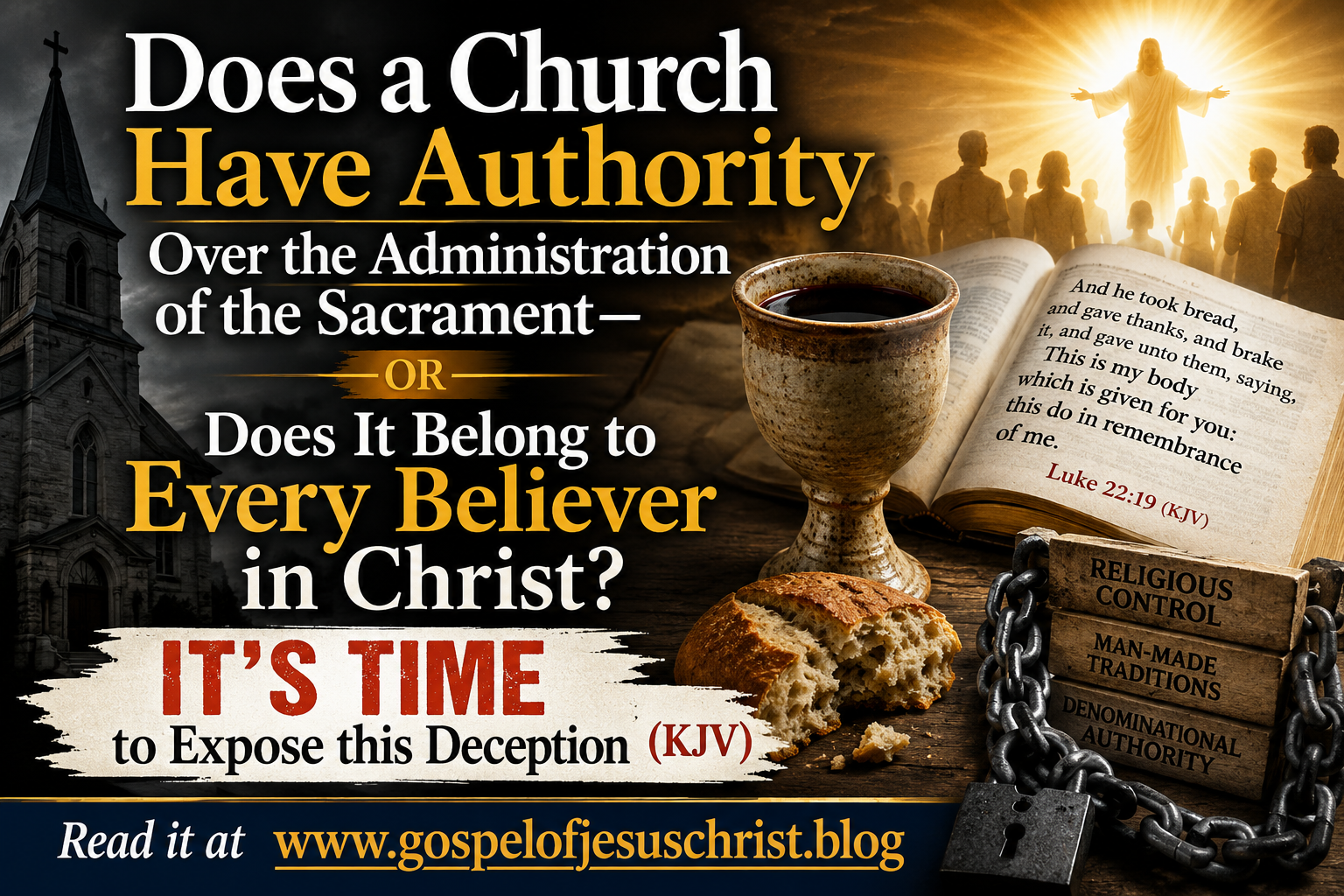
Today, I wanted to investigate the “Sacrament,” and if a church has exclusive rights over the administering of this ordinance. Let’s begin by understanding what the sacrament is, as Jesus Christ taught Himself when He was on the earth.
Jesus’ teaching about what Christians often call the Sacrament, Communion, or the Lord’s Supper is remarkably simple in the KJV. On the night before His crucifixion, Jesus took ordinary bread and the cup and gave them profound meaning: His followers were to use them to remember Him and what He was about to accomplish through His sacrifice.
Jesus took the bread
Luke 22:19 — KJV
“And he took bread, and gave thanks, and brake it, and gave unto them, saying, This is my body which is given for you: this do in remembrance of me.”
Notice the heart of His instruction: “in remembrance of me.” The bread directs our thoughts toward the body of Jesus Christ, which He willingly gave for us. The emphasis is not upon a church organization, building, or elaborate ceremony—it is upon Christ and His sacrifice.
Jesus then gave them the cup
Luke 22:20 — KJV
“Likewise also the cup after supper, saying, This cup is the new testament in my blood, which is shed for you.”
Matthew records Jesus saying:
Matthew 26:27–28 — KJV
“And he took the cup, and gave thanks, and gave it to them, saying, Drink ye all of it;
For this is my blood of the new testament, which is shed for many for the remission of sins.”
The cup therefore points us toward Christ’s blood shed for our sins. The bread remembers His body given for us; the cup remembers His blood shed for us.
Jesus also connected it with His coming Kingdom
Paul later records the instruction he received from the Lord:
1 Corinthians 11:23–26 — KJV
“For I have received of the Lord that which also I delivered unto you, That the Lord Jesus the same night in which he was betrayed took bread:
And when he had given thanks, he brake it, and said, Take, eat: this is my body, which is broken for you: this do in remembrance of me.
After the same manner also he took the cup, when he had supped, saying, This cup is the new testament in my blood: this do ye, as oft as ye drink it, in remembrance of me.
For as often as ye eat this bread, and drink this cup, ye do shew the Lord’s death till he come.”
That last sentence beautifully summarizes its purpose: “ye do shew the Lord’s death till he come.”
Jesus did not teach that taking the bread and cup saves us. Salvation comes through faith in Him. Nor do these passages specify that a particular denomination must authorize the remembrance.
What Jesus explicitly commanded was wonderfully personal and Christ-centered: take the bread, give thanks, remember His body given for you; take the cup, remember His blood shed for you; and continue remembering His death while looking forward to His return.
The New Testament does not state that membership in a particular institutional church is what gives the bread and cup their meaning or saving power. Jesus Christ Himself is the center of it all.
Is There a Priesthood Associated with the Sacrament?
Based strictly on the KJV New Testament, no special priesthood office is stated as being required to bless or administer the bread and cup. There is no mention there of Jesus first conferring a special priesthood authority upon someone before that person could administer the bread and cup.
Paul’s instructions to the Corinthian believers likewise contain no requirement for a priesthood holder to perform a prescribed blessing. Paul writes, “The cup of blessing which we bless, is it not the communion of the blood of Christ? The bread which we break, is it not the communion of the body of Christ?” (1 Corinthians 10:16).
In 1 Corinthians 11:23–26, Paul tells believers to remember Christ through the bread and cup, but again gives no priesthood qualification for who may administer them. The emphasis is upon remembering Christ, proclaiming His death, examining oneself, and participating reverently.
Is There a Specific Prayer that Must be Said Prior to Receiving the Sacrament?
The New Testament does not give a required word-for-word prayer that must be recited over either the bread or the cup. What Jesus did give us is a pattern: He gave thanks, then explained what the bread and cup represented.
For the bread — Luke 22:19 (KJV):
“And he took bread, and gave thanks, and brake it, and gave unto them, saying, This is my body which is given for you: this do in remembrance of me.”
For the cup — Matthew 26:27–28 (KJV):
“And he took the cup, and gave thanks, and gave it to them, saying, Drink ye all of it;
For this is my blood of the new testament, which is shed for many for the remission of sins.”
Paul gives the same basic pattern in 1 Corinthians 11:23–26: Jesus took bread, gave thanks, broke it, and told His followers to do this in remembrance of Him. With the cup, He again directed their attention to the new testament in His blood. There is no prescribed prayer in these passages that Christians are commanded to repeat word-for-word.
So, if you were taking the Lord’s Supper at home, a simple prayer consistent with the KJV could be:
For the bread:
“Father, I thank thee for Jesus Christ and for His body given for me. As I eat this bread, I shall always remember His sacrifice for my sins and give thanks for the salvation I have through Him. In the name of Jesus Christ, Amen.”
For the cup:
“Father, I thank thee for the blood of Jesus Christ, shed for the remission of sins. As I drink this cup, I shall always remember His blood shed for me and the new covenant made possible through His sacrifice. In the name of Jesus Christ, Amen.”
Those are examples, not prayers commanded by Scripture. The biblical requirement is much simpler: give thanks and remember Jesus Christ—His body given for you and His blood shed for you. The power is not in saying an exact formula correctly; the focus is upon Jesus Christ and what He accomplished at the cross.
One thing that I’ve learned over the past 4 years of studying the Gospel of Jesus Christ as He and His apostles taught when they were upon the earth is that this Gospel is VERY SIMPLE. It is earthly religions that make it so complicated.
In my own spiritual progression, I have found less of an interest in a church, and more of a direct and personal connection with the Savior, Jesus Christ. This feels complete, and how actual worship should be.
By doing this, it has also exposed just how cleaver satan is in deceiving some “Religious People.” He has done it with a “Trojan Horse” of their own religion. Who would have thought that a person’s religion would be the reason that a person does not make it to heaven, or to certainly miss the rapture?
God knew this would happen, and gave us this warning:
Matthew 24:24 (KJV).
“For there shall arise false Christs, and false prophets, and shall shew great signs and wonders; insomuch that, if it were possible, they shall deceive the very elect.
I invite all of you, regardless of your “Church Status” to participate in a frequent sacrament, as a way to worship and remember our Lord and Savior Jesus Christ.
Discover more from The Gospel of Jesus Christ
Subscribe to get the latest posts sent to your email.

