August 7, 2026 | www.gospelofjesuschrist.blog | River Wilde
(The views expressed in this article are my personal interpretations of the Bible, particularly concerning biblical prophecy and the end times. They have come to me through endless study of the scriptures, as well as frequent prayerful searching for TRUTH. They are offered for discussion, study, and personal reflection. I do not claim special revelation, nor do I speak on behalf of any church, denomination, religious organization, or its leaders. Readers are encouraged to study the Scriptures for themselves, seek God’s guidance through prayer, and draw their own conclusions.)
Truth is important, not opinions, or even beliefs. Most people who are religious seek the truth, for it is the truth that will always exist, regardless of what a person believes.
When we all pass on into the “next life” we will not go in different directions, depending upon what we believe. We will proceed as God has planned…ONE PLAN for all mankind. This does not mean that we will all end up in the same place, but we will all follow God’s plan, whatever that is.
We have been told by an apostle of Jesus Christ, who taught the gospel alongside the Savior, that these “Last Days” will be filled with deception. A deception that will be so great that even the VERY ELECT are at risk.
Matthew 24:24 (KJV)
“For there shall arise false Christs, and false prophets, and shall shew great signs and wonders; insomuch that, if it were possible, they shall deceive the very elect.“
If you believe that you are a very solid religious person, this warning includes you. Religion, led by a false prophet has the potential to cleverly deceive you. And, this is exactly how the adversary would reach the very elect…he would do it through their own church, under the influence of a false prophet. Nobody would EVER expect satan to use a “Christian” religion to deceive its members. Especially the very elect ones.
I write this article out of love, and a desire to offer information so that YOU can determine what is TRUE, and what is merely a deception from a false prophet which we have been warned about through this scripture teaching.
I was a lifetime member of the church, serving in many leadership positions. I even worked at the temple.
Four years ago, I had a tremendous desire to learn the TRUTH about the gospel of Jesus Christ. My church leaders told me what they saw as truth, because a “prophet” had “restored” the Gospel of Jesus Christ. As I dove into the direct teachings of Jesus Christ and His apostles, as recorded in the KJV New Testament, I found the word that the church was using, “restored” was indeed a deception in itself.
It had NOT been restored by Joseph Smith, it had been CHANGED!!! The Mormon gospel is NOT the Gospel that Jesus Christ and His apostles taught, and you should discover this deception for yourselves.
With today’s technology, just enter the following into a search tool online: “What are the differences in the church of Jesus Christ of latter-day saints doctrine compared to the doctrine teachings of Jesus Christ and His apostles taught in the KJV of the Bible?”
Then, please, especially study the following topics:
What does it mean to be Born again? (It is NOT Baptism)
How does a person become “in Christ”
Keep your study centered on the teachings that are recorded in the New Testament, ONLY nothing else! Why?
Galatians 1:8–9 (KJV)
8 “But though we, or an angel from heaven, preach any other gospel unto you than that which we have preached unto you, let him be accursed.
9 As we said before, so say I now again, If any man preach any other gospel unto you than that ye have received, let him be accursed.”
Galatians 1:8–9 teaches that the Gospel of Jesus Christ must never be changed, added to, or replaced, regardless of who claims to bring a new message. Paul makes the warning extraordinarily strong by saying that even if he himself, another apostle, or even “an angel from heaven” preached a different gospel from the one already received, that messenger should be “accursed.”
The authority of the messenger—whether a respected religious leader, prophet, apostle, or supernatural being—does not make a different gospel true. Instead, every religious claim must be tested against the Gospel already revealed through Jesus Christ and His apostles. The passage therefore warns believers not to accept another gospel simply because its source appears impressive, spiritual, miraculous, or authoritative; the message must agree with the Gospel of Christ already given.
All religious teachings must be tested and compared to that which Jesus Christ and His apostles taught.
Now, let’s get to the topic of the day. The Temple. Let’s simply consider facts, and let you draw your own conclusions.
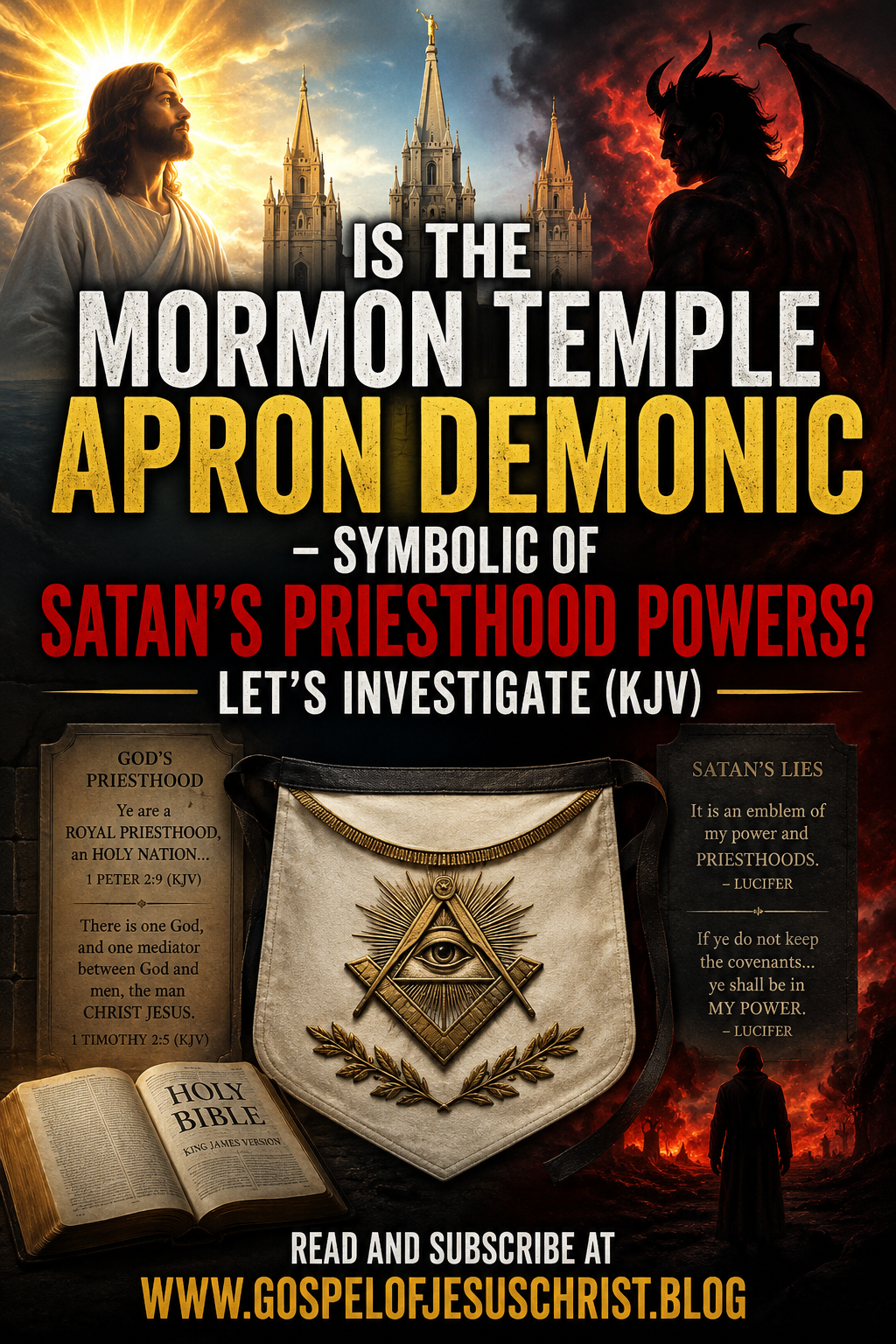
There was a passage in a former version of the LDS temple endowment which shows satan talking to Adam and Eve. Sources comparing versions report that the explicit “power and priesthoods” exchange was removed in 2019.
The relevant sequence went essentially like this:
ADAM: “What is that apron you have on?”
LUCIFER: “It is an emblem of my power and Priesthoods.”
ADAM: “Priesthoods?”
LUCIFER: “Yes, Priesthoods.”
Shortly afterward, Lucifer tells Adam and Eve that they are naked and instructs them to make fig-leaf aprons and hide. Then the ceremony instructs the temple participants to put on their aprons. Historical transcripts preserve that sequence.
There is an important distinction, though: the script does not explicitly say that Adam, Eve, or temple patrons are putting on Lucifer’s actual apron or receiving Lucifer’s priesthood.
Lucifer’s apron is described as an emblem of his power and priesthoods; afterward he instructs Adam and Eve to make their own aprons from fig leaves.
In historical versions of the LDS endowment, Lucifer described his apron as an emblem of his ‘power and Priesthoods.’ Shortly afterward, Lucifer instructed Adam and Eve to make aprons, and temple participants were then instructed to put on their own aprons.”
This sequence deserves careful examination because the symbolism raises an obvious question: Why does Lucifer introduce the apron into the ceremony? In the historical endowment, Lucifer is already wearing an apron when Adam asks what it represents. Lucifer’s answer is striking: “It is an emblem of my power and Priesthoods.” The apron therefore enters the story with an explicitly stated symbolic meaning connected to Lucifer. Shortly afterward, Lucifer draws Adam and Eve’s attention to their nakedness and directs them to make aprons of fig leaves. Temple participants are subsequently instructed to put on their own aprons.
We should be careful not to claim more than the historical script actually says. It does not explicitly state, “This apron represents Satan’s priesthood,” when Adam, Eve, or temple patrons put theirs on. Neither does it say that wearing the apron transfers Lucifer’s power or priesthood to them. Those conclusions would go beyond the words of the ceremony. Nevertheless, from an investigative standpoint, the sequence raises a legitimate question: Why would an emblem first identified by Lucifer in connection with his own power and priesthoods become an article subsequently worn by Adam and Eve—and symbolically by temple participants?
The question becomes even more interesting when we return to the biblical account. Genesis tells us that after Adam and Eve sinned, “they sewed fig leaves together, and made themselves aprons” (Genesis 3:7, KJV). But Scripture does not say that Satan instructed them to make those aprons.
That detail comes from the temple dramatization, not Genesis. In the Bible, the fig-leaf coverings represent Adam and Eve’s own unsuccessful response to their fallen condition. Later, God Himself provides their covering:
“Unto Adam also and to his wife did the LORD God make coats of skins, and clothed them” Genesis 3:21, KJV.
Biblically, therefore, there is a significant contrast between the covering human beings attempted to make for themselves and the covering God ultimately provided.
That raises another important question: Why preserve the fig-leaf apron as a sacred ceremonial garment when Genesis emphasizes that God subsequently clothed Adam and Eve differently?
The Bible never commands believers to wear a fig-leaf apron, never identifies such an apron with God’s priesthood, and never incorporates it into Christian worship. In the New Testament, believers are instead told to “put ye on the Lord Jesus Christ” (Romans 13:14) and that those who belong to Christ have “put on Christ” (Galatians 3:27). The emphasis moves away from physical ritual clothing and toward being spiritually clothed in Christ.
There is another feature worth examining. In the historical ceremony, Lucifer speaks of his “Priesthoods” in the plural. Yet Scripture never describes Satan as possessing a legitimate priesthood from God. Biblical priesthood belongs to those whom God appoints, and the New Testament ultimately centers priesthood authority upon Jesus Christ, our “great high priest” (Hebrews 4:14).
Satan is instead described as the deceiver, adversary, tempter, and “the father of lies” (John 8:44). Consequently, when a religious ceremony places the language of “priesthoods” into Lucifer’s mouth, it is reasonable for a Bible-believing reader to ask what theological purpose that statement is intended to serve.
None of these observations by themselves prove that the LDS apron is consciously intended to represent Satanic authority. The evidence does not justify making that claim as a fact. But investigation does not require us to ignore uncomfortable questions either. The historical sequence is real:
Lucifer wears an apron;
Lucifer identifies his apron with his power and priesthoods;
Lucifer instructs Adam and Eve concerning fig-leaf aprons;
And participants subsequently put on aprons themselves.
Readers should be permitted to see the complete sequence, compare it directly with Genesis 3, and decide for themselves whether the symbolism is consistent with what Scripture teaches.
Perhaps the most important principle is the one Paul gave concerning religious claims generally:
“Prove all things; hold fast that which is good” 1 Thessalonians 5:21, KJV.
Sacred traditions should not be protected from examination simply because they are sacred to those who practice them. Neither should they be condemned through exaggeration. We should examine the actual words, compare them carefully with Scripture, distinguish fact from interpretation, and then ask the question that matters most:
Does this teaching lead us toward the simple Gospel and authority of Jesus Christ—or does it introduce religious concepts that cannot be found in His Word?
Additionally, let’s do a deep dive into another aspect of the temple endowment ceremony.
“If I Break My Temple Covenants, Am I Then in Satan’s Power?“
One of the most striking statements found in historical versions of the LDS temple endowment occurs when Lucifer addresses the people participating in the ceremony. After temple patrons have entered into solemn covenants, Lucifer warns that if they do not live up to the covenants made at the temple altars, “they will be in my power.”
This deserves careful examination. Who is speaking? Lucifer. What condition does he establish? Failure to keep the covenants. What consequence does he announce? Being in his power. Even if the scene is intended symbolically, an important question remains: Why is Satan given the role of announcing the consequence of failing to keep sacred temple covenants?
The question becomes even more significant when we consider the breadth of the covenants themselves. Temple participants covenant concerning obedience, sacrifice, chastity, the Gospel, and consecration. These are serious lifelong commitments. Yet every Christian, including every temple-going Latter-day Saint, remains an imperfect human being. If Lucifer’s statement were interpreted literally to mean that any failure to perfectly keep every covenant places the individual under Satan’s power, who could possibly remain free from that consequence?
This is where comparison with the New Testament becomes important. Scripture openly acknowledges man’s inability to establish righteousness through perfect performance:
“For all have sinned, and come short of the glory of God” Romans 3:23, KJV.
Paul then explains that believers are:
“justified freely by his grace through the redemption that is in Christ Jesus” (Romans 3:24).
Salvation therefore rests upon Christ’s completed work rather than upon our ability to perfectly fulfill religious obligations.
Paul makes the distinction even clearer in Ephesians 2:8–9:
“For by grace are ye saved through faith; and that not of yourselves: it is the gift of God: Not of works, lest any man should boast.”
Titus likewise declares,
“Not by works of righteousness which we have done, but according to his mercy he saved us” Titus 3:5, KJV.
The New Testament certainly commands Christians to obey God, live holy lives, and remain faithful, but those actions flow from salvation; they are not presented as a system in which one broken ceremonial covenant transfers ownership of the believer to Satan.
In fact, Paul describes the position of someone who belongs to Jesus Christ very differently:
“There is therefore now no condemnation to them which are in Christ Jesus” Romans 8:1, KJV.
He later asks, “Who shall separate us from the love of Christ?” and concludes that nothing in creation “shall be able to separate us from the love of God, which is in Christ Jesus our Lord” (Romans 8:35, 39).
That raises an important theological question: If a person has genuinely been born again and belongs to Jesus Christ, can Satan acquire that person simply because he or she imperfectly fulfills a temple covenant?
This does not mean covenants, obedience, or righteous living are unimportant. Jesus repeatedly commanded His followers to obey Him. But biblical obedience must be distinguished from earning salvation or maintaining freedom from Satan through flawless religious performance. The Gospel places our confidence in Christ’s righteousness and His finished work, while good works become the fruit of the believer’s relationship with Him.
There is also something psychologically significant about the historical presentation that deserves consideration without exaggeration.
The ceremony did not merely have a religious instructor warn participants about disobedience; it placed the warning directly into the mouth of Lucifer. For a sincere participant who believed the ceremony represented eternal realities, hearing Satan declare that failure to keep every covenant would place that person in his power could understandably create a profound sense of obligation or fear. Whether that was the intended effect is a separate question and should not be asserted without evidence—but the wording itself is worthy of examination.
The fairest investigation therefore asks readers not to accept either an LDS defense or a critic’s interpretation automatically. Instead, place the historical words beside the New Testament and ask:
What does Jesus Christ say places us securely in Him?
What does Scripture say happens when a Christian sins and repents?
Does the New Testament teach that believers must make temple covenants to remain outside Satan’s power?
And where did Jesus or His apostles institute an endowment ceremony containing these requirements?
Those questions take us back to the principal Paul gave in 1 Thessalonians 5:21 (KJV): “Prove all things; hold fast that which is good.” If something truly comes from God, careful examination should strengthen rather than threaten it.
I invite everyone who is reading this to answer only to God, and no man nor religion. To me, there is an obvious unhealthy commitment that some followers can develop toward their “prophet.” In conversations with some of my close friends, they have been adamant that if the prophet were to tell them one thing, but after taking the matter directly to God, they believed God had told them the opposite, they would still follow the prophet—even over what they believed was personal revelation from God.
This is not obedience to God. This is not demonstrating greater faith. It is surrendering your spiritual discernment to another human being. If you genuinely believe God has spoken, but nevertheless choose the words of a man because of his religious office, then an important question must be asked: Who has actually become your highest authority? “But the prophet would never lead us astray?” Who made that promise? It certainly was not God. You will not find that promise anywhere in the bible, NOR the Book of Mormon. The promise comes from another “prophet” in the same organization. Is it logical to think that a promise this important should come God, and not the same organization? The adversary is indeed very cleaver in his deceptive techniques.
The Bible establishes the order very clearly. When the apostles were commanded by religious authorities to stop preaching Jesus Christ, Peter and the other apostles answered:
Acts 5:29 (KJV): “We ought to obey God rather than men.”
Notice what they did not say: “Obey your religious leaders because God appointed them.” They recognized that whenever the commands of men conflict with God, God must remain supreme. No prophet, pastor, priest, apostle, bishop, church president, or religious institution can occupy the position that belongs to God alone. If you believe otherwise, buckle-up…Things are going to get incredibly hard for you.
This becomes especially important because the Bible repeatedly warns that religious leaders themselves can be wrong. Jesus did not say that everyone claiming prophetic authority should automatically be trusted. He said exactly the opposite:
“Beware of false prophets, which come to you in sheep’s clothing” (Matthew 7:15, KJV).
Why would Jesus give such warnings if the safe course were simply to trust anyone occupying the recognized office of prophet?
Do not believe something merely because a “prophet” says it. Do not even believe it merely because an angel says it. Compare the message with the Gospel you have already received, and is recorded in the New Testament.
That is spiritual discernment.
The people of Berea were actually praised for doing exactly this. When Paul and Silas preached to them, they did not simply accept their teaching because apostles were speaking. They “searched the scriptures daily, whether those things were so” (Acts 17:11, KJV).
Imagine that: they checked the teachings of an Apostle against Scripture, and the Bible calls them “more noble” for doing it.
This raises a very serious question for every Christian—not merely Latter-day Saints: Would you be willing to discover that your religious leader is wrong? If the answer is no, then how could you ever recognize a false prophet?
If every contradiction is automatically explained away because “the prophet cannot lead us astray,” then the claim itself has become impossible to test. Whatever the leader teaches becomes correct simply because the leader taught it. Please reconsider that thought.
This is precisely why our allegiance must ultimately belong to Jesus Christ rather than an institution or personality. Paul wrote, “For there is one God, and one mediator between God and men, the man Christ Jesus” (1 Timothy 2:5, KJV).
Jesus Christ stands between humanity and God—not a modern prophet, church president, priesthood hierarchy, denomination, or temple.
This does not mean Christians should reject teachers or religious leadership. Scripture recognizes pastors, teachers, elders, and other servants of God. But there is an enormous difference between respecting a teacher and granting that teacher unquestionable spiritual authority. A true teacher should continually point people beyond himself and toward Jesus Christ and the Word of God.
John therefore commanded believers:
1 John 4:1 (KJV): “Beloved, believe not every spirit, but try the spirits whether they are of God: because many false prophets are gone out into the world.”
Notice that God places responsibility upon you to test what you are being taught. You cannot surrender that responsibility to the very person whose teachings need to be tested.
And this principle applies to me as well. Do not believe something simply because I wrote it in this article. Open your King James Bible. Read the passages in context. Study them carefully. Pray. Compare what I have written with the words of Jesus Christ and His apostles. If I teach something contrary to God’s Word, reject what I have written and follow God.
I do not want anyone placing their faith in River Wilde. I do not want anyone replacing one religious authority with another. My purpose is to point you toward Jesus Christ and encourage you to investigate these things for yourself.
Your salvation is too important to outsource.
When you eventually stand before God, you will not be able to place responsibility for your beliefs upon your church, your parents, your bishop, your pastor, your prophet, or the religious tradition in which you were raised. Each of us must ultimately answer to God.
So, investigate. Ask difficult questions. Compare teachings with Scripture. Do not be frightened by truth. If something really comes from God, examination will not destroy it.
I pray for those of you who read my writings, that you might have the DESIRE to seek truth, approach it with HUMILITY, and ASK GOD for help in finding that truth. For I KNOW the outcome…God will lead you to truth, as He has done for me.
There has NEVER been such an important time to learn truth as there is right now. The final seven years on earth is about to begin. Don’t you think that a true Prophet of God would be teaching you all of the end times prophecies, as recorded in the Bible, so that you could be warned about the possibility of losing your very soul? Then, why ISN’T HE? (May I provide a thought here for you…The less a person knows, the easier they are to be deceived.)
I chose to trust God, over a person declaring a religious title, and I have learned all of Bible end times prophecies in detail because of it. I KNOW what is coming, do you? I have a plan so that I will not be deceived into taking the mark of the beast, do you? I have a my plan, as well as knowledge of the end times, because I listen to the PROPHETS of God, and have studied what God has revealed to them, as recorded in the bible. Have you?
Please take back the ownership of your own spirituality. It is your responsibility, not a church leader…especially one who might not have your best interest at stake.
Discover more from The Gospel of Jesus Christ
Subscribe to get the latest posts sent to your email.

