June 22, 2026 | www.gospelofjesuschrist.blog | River Wilde
For most of her life, Emily believed she was on the right path.
She attended church regularly.
She tried to live a good life.
She served others whenever she could.
She believed in God.
And because she was religious, she assumed she was prepared to meet Him.
If someone had asked whether she was going to heaven, her answer would have come quickly.
“I certainly hope so.”
One evening, while reading through the Gospel of John, she came across words spoken directly by Jesus:
“Except a man be born again, he cannot see the kingdom of God.” (John 3:3 KJV)
She stopped reading.
Born again?
She had heard the phrase many times before, but suddenly it felt different.
Jesus had not said, “Except a man attend church.”
He had not said, “Except a man perform enough good works.”
He had not said, “Except a man belong to the correct religion.”
He said, “Ye must be born again.”
The words lingered in her mind long after she closed her Bible.
Over the next several weeks, she searched the Scriptures.
Again and again, she discovered the same truth.
Salvation was not something people earned.
It was something God provided.
Jesus came to save sinners.
Not the deserving.
Not the perfect.
Not the religious.
Sinners.
Then she came across another passage.
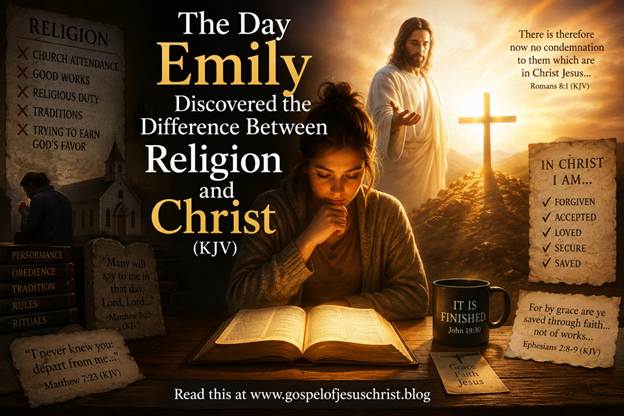
“There is therefore now no condemnation to them which are in Christ Jesus…” (Romans 8:1 KJV)
In Christ.
The phrase appeared throughout the New Testament.
Paul spoke of being in Christ.
The apostles spoke of being in Christ.
The promises of salvation belonged to those who were in Christ.
Yet a troubling question formed in her mind.
Am I actually in Christ?
Or am I merely participating in religion?
For years she had focused on what she was doing for God.
Now she began focusing on what Christ had already done for her.
She read about the cross.
She read about the empty tomb.
She read about the blood that was shed for the forgiveness of sins.
She read the words Jesus spoke just before His death:
“It is finished.” (John 19:30 KJV)
Finished.
Not started.
Not mostly completed.
Finished.
The payment for sin had already been made.
The sacrifice had already been accepted.
The work of salvation had already been accomplished.
All that remained was to trust Him.
One quiet evening, sitting alone with her Bible open, Emily finally understood.
Her confidence had been resting in her efforts.
Her church attendance.
Her obedience.
Her religious performance.
But none of those things could remove a single sin.
Only Jesus could do that.
With tears in her eyes, she bowed her head.
For the first time, she placed her faith completely in Christ alone.
Not Christ plus religion.
Not Christ plus good works.
Not Christ plus ceremonies.
Christ alone.
A peace settled over her heart.
The uncertainty disappeared.
The striving ended.
The burden lifted.
She knew she belonged to Him.
Not because she had become perfect.
But because she had been born again.
Years later, when people asked her what had changed, she would smile and answer:
“I spent most of my life trying to reach God.”
Then she would pause.
“And one day I discovered that God had already reached down to me through Jesus Christ.”
Looking back, she realized that the greatest deception is not always unbelief.
Sometimes it is believing that religious activity can replace a personal relationship with Christ.
And if there was one message, she wished every person could hear before it is too late, it would be this:
Do not trust in your church.
Do not trust in your works.
Do not trust in your traditions.
Do not trust in your own goodness.
Trust entirely in Jesus Christ, who died for your sins and rose again.
For one day every person will stand before God.
And on that day, the most important question will not be how religious you were.
The question will be whether you were in Christ.
For those who are in Him have already passed from death unto life, and their salvation rests not upon what they have done, but upon what Jesus Christ has already finished.
“Come unto me, all ye that labour and are heavy laden, and I will give you rest.
Take my yoke upon you, and learn of me; for I am meek and lowly in heart: and ye shall find rest unto your souls.
For my yoke is easy, and my burden is light.“
— Matthew 11:28–30 (KJV)
In this passage, Jesus is inviting people who are weary from the burdens of sin, fear, guilt, and trying to earn God’s favor through their own efforts. A yoke was a wooden harness placed on oxen for work. Jesus is saying that when we come to Him and trust Him, we are no longer carrying the crushing burden of trying to save ourselves. Instead, we walk with Him, and He provides the strength
“For by grace are ye saved through faith; and that not of yourselves: it is the gift of God:
Not of works, lest any man should boast.”
— Ephesians 2:8–9 (KJV)
The Christian life may still contain trials, but the burden of earning salvation has already been carried by Christ at the cross. That is why His yoke is easy and His burden is light.
I invite all of you to follow Emily’s example of becoming “Born Again” as taught in the New Testament. Your personal relationship with Jesus Christ is what is important in this life, and will ensure that we are included in God’s rescue plan of the rapture that will soon happen.
Discover more from The Gospel of Jesus Christ
Subscribe to get the latest posts sent to your email.

