May 1, 2026 | www.gospelofjesuschrist.blog | River Wilde
We’ve all had those moments when we are deep in reflection, and taught by the Holy Spirit. Yesterday was certainly one of those moments for me. Something that now makes perfect sense to me regarding the decades long fighting over the temple mount, and the inability for the Jewish people to rebuild “Solomons Temple.”
For thousands of years, the worship of God among the children of Israel was centered on one sacred place—the temple. First the temple built by Solomon, and later the rebuilt temple in Jerusalem, stood as the appointed location where sacrifices were offered for sin, thanksgiving, and atonement. According to the Law given through Moses, these sacrifices were not optional—they were commanded.
“Then shalt thou kill the bullock before the LORD… and the priests… shall bring the blood, and sprinkle the blood round about upon the altar.”
(Leviticus 1:5, KJV)
The shedding of blood was central to the forgiveness of sins:
“For it is the blood that maketh an atonement for the soul.”
(Leviticus 17:11, KJV)
The temple, therefore, was not merely symbolic—it was essential under the Law. Without it, the system of sacrifices could not function.
The Destruction That Changed Everything
In 70 A.D., Jerusalem was overtaken by the Roman army, and the temple was destroyed. Not one stone was left upon another, just as Jesus Christ had foretold:
“There shall not be left here one stone upon another, that shall not be thrown down.”
(Matthew 24:2, KJV)
From that moment forward, something remarkable—and deeply significant—occurred:
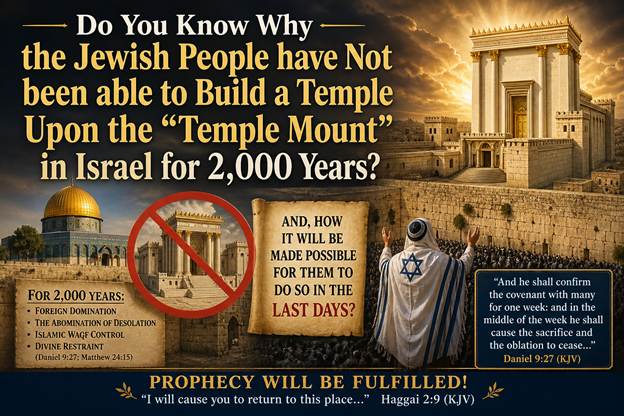
The Jewish people have not been able to offer sacrifices according to the Law of Moses.
For nearly 2,000 years, the Jewish people have not been able to offer sacrifices because there was no temple. No altar. No priesthood functioning in the temple. No sacrificial system as commanded in the Law. The very foundation of the Old Covenant system has been absent.
Consider the significance of this: Temple sacrifices were at the very heart of the Law of Moses, yet they ceased—and to this day, they have never resumed.
Under the Law given through Moses, the Jewish people could not simply build an altar or temple in any place they chose in order to continue offering sacrifices unto God. The Lord appointed one specific place where His name would dwell and where sacrifices were to be offered—the place He chose for His holy house.
Scripture teaches,
“But unto the place which the Lord your God shall choose out of all your tribes to put his name there… thither thou shalt come: And thither ye shall bring your burnt offerings, and your sacrifices” (Deuteronomy 12:5–6, KJV).
That chosen place became Mount Moriah in Jerusalem, where Solomon built the Temple:
“Then Solomon began to build the house of the Lord at Jerusalem in mount Moriah” (2 Chronicles 3:1, KJV).
Because God designated that sacred location, the Jewish people could not lawfully establish temple sacrifices elsewhere. This is why, after the Temple’s destruction in 70 A.D., sacrificial worship ceased—because the altar of sacrifice belongs upon the place God appointed, known today as the Temple Mount, the very ground where His holy house once stood.
Why Would God Allow This?
To me, this was the hidden answer which became so obvious. Not only did God allow the temple not to be rebuilt, I believe He was instrumental in ensuring that this did not happen. He had created several circumstances to ensure that this temple would not be rebuilt, because He wanted the world to see His gospel being fulfilled. The temple was no longer necessary, because Christ had fulfilled that sacrifice.
God, in dramatic fashion, put a stop to sacrifices, regardless of the Jewish people wanting to continue performing them.
The Jewish people had missed the coming of the Messiah, but God would not allow them to continue with their animal sacrifices needed for the forgiveness of sin, because Christ had already fulfilled that part of the “Gospel”
The Final Sacrifice
The sacrifices of the Old Testament were never meant to be permanent. They were shadows—pointing forward to something greater.
“But this man, after he had offered one sacrifice for sins for ever, sat down on the right hand of God.”
(Hebrews 10:12, KJV)
Jesus Christ became the final and complete sacrifice for sin.
“For by one offering he hath perfected for ever them that are sanctified.”
(Hebrews 10:14, KJV)
Unlike the repeated sacrifices offered daily in the temple, Christ’s sacrifice was once—and sufficient for all time.
“And almost all things are by the law purged with blood; and without shedding of blood is no remission.”
(Hebrews 9:22, KJV)
The difference is this:
The blood of animals covered sin temporarily.
The blood of Christ removes sin completely.
No More Need for an Earthly Temple
When Jesus died, something profound happened:
“The veil of the temple was rent in twain from the top to the bottom.”
(Matthew 27:51, KJV)
This veil separated man from the presence of God. Its tearing symbolized that access to God was no longer limited to a physical place or mediated through temple rituals.
God was showing the world something unmistakable:
The way to Him was no longer through a building—but through a Person.
Jesus Himself declared:
“I am the way, the truth, and the life: no man cometh unto the Father, but by me.”
(John 14:6, KJV)
A New Temple
Under the New Covenant, the focus shifts dramatically.
“What? know ye not that your body is the temple of the Holy Ghost which is in you…?”
(1 Corinthians 6:19, KJV)
Believers themselves become the dwelling place of God.
No longer is His presence confined to stone walls in Jerusalem.
No longer is worship tied to a geographic location.
“God is a Spirit: and they that worship him must worship him in spirit and in truth.”
(John 4:24, KJV)
The destruction of the temple was not the end of God’s plan—it was the confirmation of it. The altar went silent… because the final sacrifice had already been made. And perhaps the ongoing struggle over the Temple Mount is a reminder to the world:
God has already made a way.
Not through stone… but through His Son.
The Temple in the Tribulation Period
And prophecy will yet continue. After the restrainer is removed—God’s Holy Spirit presently dwelling within His believers through the Church, taken in the event many understand as the Rapture—the way will be opened for events long foretold in Scripture to unfold.
Among those events is the rebuilding of a Temple in Jerusalem. Yet this Temple will not ultimately stand for the glory of God, but as part of the final prophetic stage of human history, becoming the setting for mankind’s greatest rebellion against Heaven and one of the clearest signs that the return of Jesus Christ is drawing near.
The prophet Daniel foresaw a time when Jewish sacrifices would resume, requiring a functioning Temple or sanctuary in Jerusalem. He wrote,
“And he shall confirm the covenant with many for one week: and in the midst of the week he shall cause the sacrifice and the oblation to cease…” (Daniel 9:27, KJV).
This prophecy reveals that temple worship will be restored, but only temporarily, for in the middle of that seven-year period, the Antichrist will violently stop those sacrifices and desecrate what was meant to be holy.
Jesus Himself confirmed this future event when He warned,
“When ye therefore shall see the abomination of desolation, spoken of by Daniel the prophet, stand in the holy place…” (Matthew 24:15, KJV).
The phrase “holy place” refers specifically to the sacred inner area of the Temple, making it clear that a literal Temple must once again stand in Jerusalem for this prophecy to be fulfilled. Christ’s warning points forward to a moment of profound defilement—an event so significant that He urged readers to understand its meaning.
Paul adds even greater detail, describing the Antichrist as the “man of sin” who will exalt himself above all that is called God. He writes that this evil ruler will sit
“in the temple of God, shewing himself that he is God” (2 Thessalonians 2:3–4, KJV).
This is perhaps the clearest prophecy of all concerning the coming Temple: it will exist in the last days, the Antichrist will enter it, and there he will commit the ultimate act of blasphemy by declaring himself to be God. What began as restored worship will become the stage for the greatest deception the world has ever known.
The book of Revelation also points to a future Temple. John was told,
“Rise, and measure the temple of God, and the altar, and them that worship therein” (Revelation 11:1, KJV).
This vision includes the Temple, the altar, and worshippers actively present—further evidence that a rebuilt Temple in Jerusalem is part of God’s prophetic timeline. Piece by piece, Scripture paints a consistent picture: a Temple will rise again, sacrifices will resume, the Antichrist will defile that holy place, and the world will witness the fulfillment of prophecy just before the glorious return of Jesus Christ.
It has become clear to me now why the Jewish people have not been able to have a temple to continuing offering sacrifices, and how God wanted to show the world that this was no longer necessary because of the sacrifice of His Son.
As we view the events that are happening in the world today, it is clear to see that many are a result of the decisions of mankind…Yet, as we include the Holy Spirit, we can clearly see the Hand of God working to navigate His Plan on earth.
Discover more from The Gospel of Jesus Christ
Subscribe to get the latest posts sent to your email.

