April 27, 2026 | www.gospelofjesuschrist.blog | River Wilde
There comes a moment in every honest life when the weight of our own shortcomings becomes impossible to ignore. It is not always a loud or dramatic realization. Sometimes it is quiet—an inward awareness that, despite our best efforts, we have fallen short. We have spoken carelessly, acted selfishly, withheld love, or walked knowingly in the wrong direction. In those moments, the question rises with urgency: Can I truly be forgiven?
The New Testament answers this question with clarity and compassion. Forgiveness is not reserved for the nearly perfect or the outwardly religious. It is offered freely to those who come in humility, recognizing their need for grace. The message of Jesus Christ is not one of condemnation for the repentant heart, but of invitation.
“If we confess our sins, he is faithful and just to forgive us our sins, and to cleanse us from all unrighteousness.”
— 1 John 1:9 (KJV)
This promise is deeply personal. It does not say that forgiveness must be earned through effort, nor does it require a lifetime of proving one’s worthiness. Instead, it reveals the character of God—faithful and just—ready to forgive and to cleanse. For the one seeking forgiveness, this truth is both humbling and liberating. We are invited to come as we are, not as we wish we had been. Our confession is directly to Him in prayer, and does not require that we confess to church clergy. Through Jesus Christ, we have been given direct access to God through our prayers, unlike the people of the Old Testament.
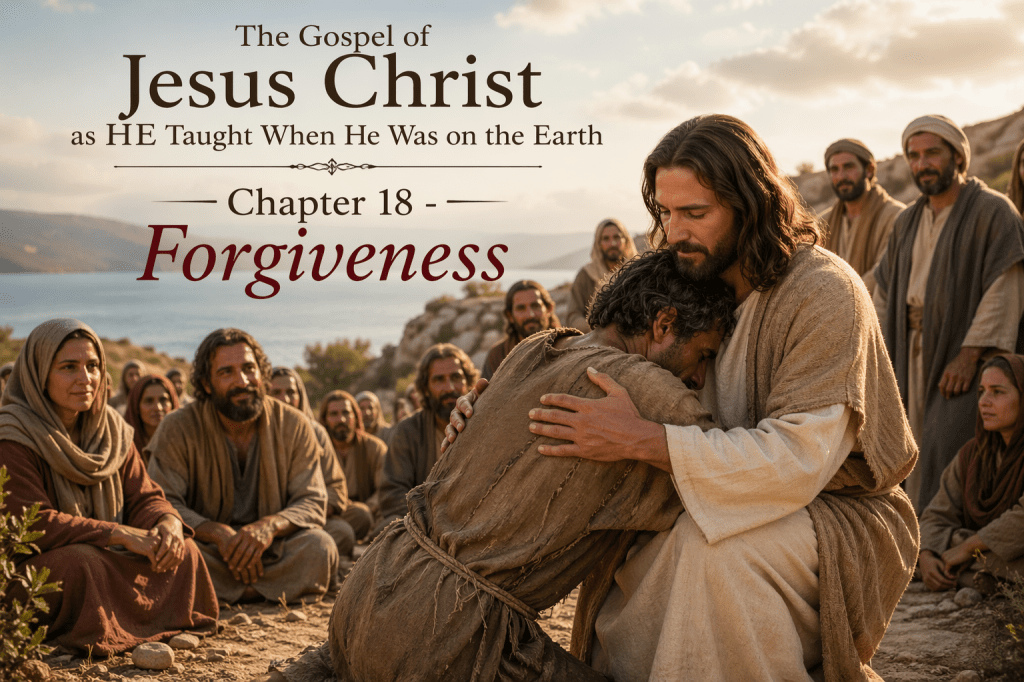
Jesus Himself illustrated this beautifully through the parable of the prodigal son. A young man squandered his inheritance in reckless living, only to find himself broken and empty. When he returned home, expecting rejection, he was instead met with compassion, embrace, and restoration.
“But when he was yet a great way off, his father saw him, and had compassion, and ran, and fell on his neck, and kissed him.”
— Luke 15:20 (KJV)
This is the heart of forgiveness from God’s perspective. It is not reluctant. It is not delayed. It is not conditional upon perfection. It is a willing and joyful restoration of the one who returns.
Yet forgiveness does not end with what we receive. It extends into how we live and how we treat others. The same grace that is offered to us is expected to flow through us. This is where the teaching of Christ becomes both powerful and challenging.
“And be ye kind one to another, tenderhearted, forgiving one another, even as God for Christ’s sake hath forgiven you.”
— Ephesians 4:32 (KJV)
To forgive others is not to excuse wrongdoing or deny the pain that was caused. Rather, it is to release the debt—to refuse to hold onto bitterness or demand repayment for what cannot be undone. It is an act of obedience, but also an act of freedom. When we withhold forgiveness, we often find ourselves bound to the very hurt we wish to escape.
Peter once asked Jesus a question that many have quietly wondered: how many times should we forgive someone who has wronged us?
“Then came Peter to him, and said, Lord, how oft shall my brother sin against me, and I forgive him? till seven times?
Jesus saith unto him, I say not unto thee, Until seven times: but, Until seventy times seven.”
— Matthew 18:21–22 (KJV)
The point is not a number, but a condition of the heart. Forgiveness is not meant to be limited or measured. It is meant to reflect the boundless mercy that we ourselves have received.
This teaching becomes even more profound when we consider Jesus’ words from the cross. In the midst of suffering, betrayal, and injustice, He spoke not words of anger, but of forgiveness:
“Father, forgive them; for they know not what they do.”
— Luke 23:34 (KJV)
If forgiveness can be extended in such a moment, then it stands as the ultimate example for all who follow Him.
There is also a solemn warning within the New Testament regarding an unforgiving heart. Jesus made it clear that our willingness to forgive others is deeply connected to our own experience of forgiveness.
“For if ye forgive men their trespasses, your heavenly Father will also forgive you:
But if ye forgive not men their trespasses, neither will your Father forgive your trespasses.”
— Matthew 6:14–15 (KJV)
This is not meant to instill fear, but to reveal the seriousness of harboring unforgiveness. A heart that truly understands grace cannot remain hardened toward others indefinitely. The two are incompatible.
For those who have been deeply hurt, forgiveness may feel like an impossible command. The wounds may run deep, and the pain may feel justified. In such cases, forgiveness is often not a single decision, but a process—a daily surrender of the right to hold onto anger. It may require prayer, time, and the quiet work of God within the heart.
At times, the struggle to forgive others is intertwined with our own struggle to receive forgiveness. We may feel unworthy, ashamed, or beyond redemption. Yet the New Testament consistently points us back to the sufficiency of Christ’s sacrifice.
“In whom we have redemption through his blood, the forgiveness of sins, according to the riches of his grace.”
— Ephesians 1:7 (KJV)
Forgiveness is not based on our merit, but on His grace. This truth allows us to lay down both our guilt and our pride, receiving what we could never earn and extending what we ourselves have been given.
There are also moments in life when the need for forgiveness is complicated by experiences within religious systems. Some have been taught, either directly or indirectly, that forgiveness must be mediated through institutions, earned through rituals, or granted conditionally based on compliance. In such environments, the simplicity of Christ’s message can become obscured.
For those who have felt misled or burdened by such teachings, the journey back to the pure doctrine of forgiveness can be both painful and freeing. It can be difficult to separate the voice of God from the voice of those who claimed to represent Him. Feelings of betrayal may linger, especially when trust was deeply placed in leaders or systems that did not reflect the fullness of Christ’s grace.
Yet even here, forgiveness has a place. Not because the wrong was insignificant, but because holding onto that pain can hinder the healing that God desires to bring. Forgiving those who have misled us does not mean agreeing with what was taught or excusing deception. It means releasing the hold that those experiences have on our hearts, allowing truth to take root where confusion once lived.
The New Testament calls us back to something beautifully simple: a direct relationship with God through Jesus Christ, where forgiveness is freely given and freely shared. No system, no person, and no past failure can stand in the way of a heart that turns to Him.
In the end, forgiveness is not merely a doctrine to be understood—it is a life to be lived. It is the quiet choice to return to God again and again, trusting in His mercy. It is the daily decision to release others from their debts, just as we have been released from ours.
And in that exchange—our brokenness for His grace—we find something extraordinary: not just forgiveness, but freedom.
Discover more from The Gospel of Jesus Christ
Subscribe to get the latest posts sent to your email.

