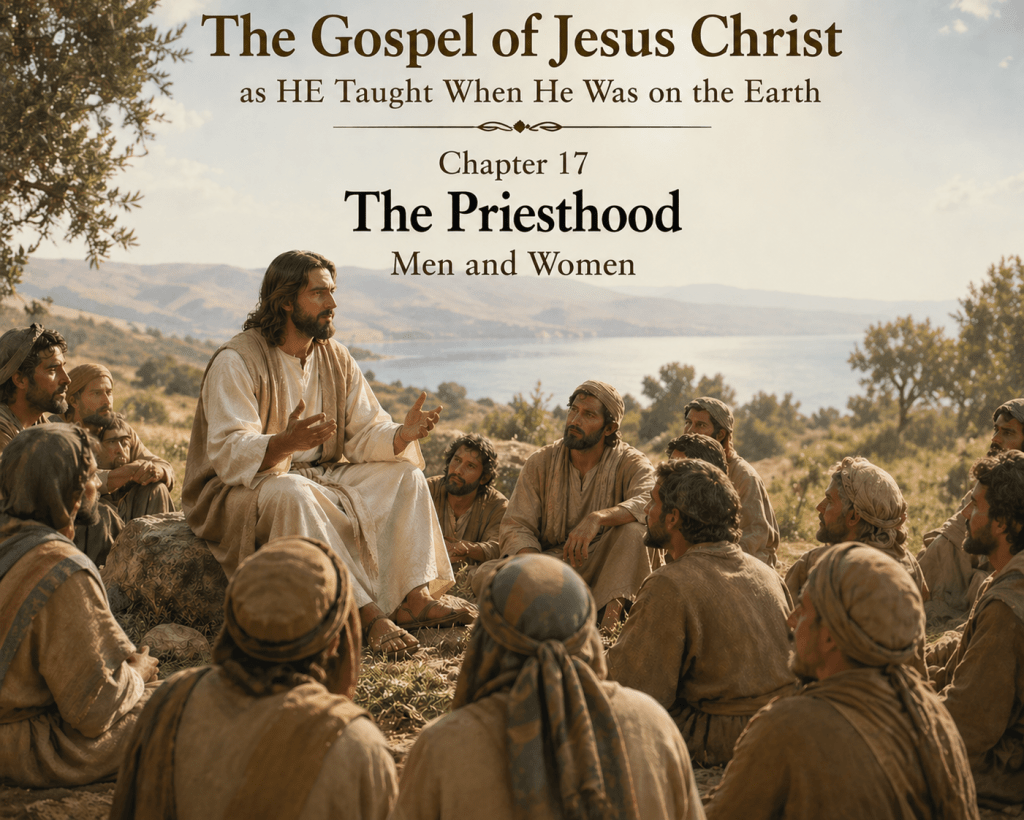
April 26, 2026 | www.gospelofjesuschrist.blog | River Wilde
Several years ago, my wife and I were given an extraordinary opportunity to serve the youth in our church. We were asked to lead what was described as a “Youth Adventure”—an experience designed to be both challenging and uplifting, combining physical activity with spiritual growth. It was a calling we accepted with excitement and a sense of purpose.
The group consisted of twenty-six young men and women between the ages of fourteen and eighteen. Our goal was to provide them with an experience that was not only fun and adventurous, but also one that would draw them closer to God. After careful planning and research, we selected a camp high in the rugged mountains of Utah. We had no idea at the time that this would become one of the most spiritually defining experiences of our lives.
In the middle of summer, we journeyed into the mountains for four days and three nights. The camp was set in a beautiful but demanding environment, complete with rope courses, rappelling cliffs, and confidence-building challenges. It was, in many ways, a place designed to stretch limits and reveal inner strength.
When we arrived, it quickly became clear that most of the youth were hesitant—if not outright fearful. The activities appeared intimidating, and many of them doubted their ability to succeed. In that moment, we realized we had chosen the perfect setting.
With gentle encouragement—and a bit of creative motivation—we invited them to step beyond their fears. Some of the young men were challenged through friendly competition, while the young women were invited simply to observe and consider trying. Soon, a few brave volunteers stepped forward.
One of the most daunting challenges was rappelling down a steep cliff. It required each participant to lean back over the edge and trust the system entirely. Before they began, we carefully taught them about the safety measures in place. Central to this was the role of the belayer—the person at the base of the rope responsible for ensuring their safety. Even if the person rappelling became unable to act, the belayer could bring them safely to the ground.
Trust became the foundation of everything we did. The youth had to trust their leaders, trust the equipment, trust the anchor secured firmly in the rock—and ultimately, trust the person holding the rope below.
We also reminded them of something even greater: that earlier that morning, we had prayed together. We had asked God for His protection, and now we would trust Him as we stepped into these unfamiliar challenges.
As I reflect on this moment even now, I am overcome with a deep sense of reverence. The Spirit of God was present in those mountains in a powerful and unmistakable way.
That first day unfolded beautifully. Every single one of those young people attempted something they had once believed was impossible. With each success came a growing sense of confidence—not just in their abilities, but in their willingness to try.
That evening, as we gathered around the campfire, the atmosphere was filled with joy. Stories of courage and accomplishment were shared freely. We offered prayers of gratitude, thanking God for the experiences of the day and for His protection.
The following day began much the same—filled with energy and adventure. But then, without warning, everything changed.
A sudden cry shattered the peace: “She’s dying! Someone help!”
Another leader and I immediately ran toward the sound. What we encountered was a moment of profound urgency and fear. A young girl—whom I will call Sandy—was lying motionless. Her skin had turned blue. She was not breathing, and there was no pulse.
We began CPR without hesitation.
In the midst of that chaos, we paused briefly to offer a prayer—a priesthood blessing—asking God to intervene. As we laid our hands upon her head, one phrase stood out in that prayer:
“We call upon the resources of this mountain to render aid.”
We immediately resumed CPR. The situation was critical. This precious seventeen-year-old girl was slipping away before our eyes.
Our camp was located about a mile up a rugged mountain road from the main access point. We called for emergency assistance and prepared to transport her down the mountain to a location suitable for rescue.
While continuing CPR, we placed her into the back of a truck and began the difficult descent.
Then something remarkable happened.
Out of nowhere, a man came running down the road. Without hesitation, he climbed into the truck and took over CPR. His actions were swift, skilled, and far beyond what we were able to provide. It was immediately evident that he had advanced medical training.
All the way down the mountain, he worked tirelessly to restore her breathing.
When we reached the base, we learned that an ambulance—not a helicopter—was on its way. Time felt unbearably slow. Yet this man continued his efforts with remarkable precision and calm.
After what felt like an eternity—though it was perhaps twenty minutes—Sandy began to breathe. A pulse returned. Gradually, life came back into her body.
Then, incredibly, she sat up.
She was breathing. She was conscious. She was alive.
When the ambulance arrived, they examined her and found everything to be… normal.
How could this be?
Later, we learned the identity of the man who had come to her aid. He was a nurse anesthetist, camping nearby, who specialized in airway emergencies. He had seen the commotion and responded immediately.
That night, he joined us around the campfire. As we expressed our gratitude, he responded with humility, yet spoke plainly: had he not been there, she likely would not have survived.
In that moment, I understood something deeply personal and powerful.
We had witnessed a miracle.
When we prayed and asked God to call upon “the resources of the mountain,” He answered—literally. He sent someone uniquely prepared, with precisely the skills needed, at exactly the right moment.
It was not coincidence. It was divine intervention.
This experience led me to reflect more deeply on the nature of God’s power—what many refer to as the “priesthood.”
According to the Bible, the priesthood is not merely an office or title, but a calling to stand before God, to serve Him, and to intercede for others. In the Old Testament, this role was given to the descendants of Aaron, who performed sacred duties under the Law of Moses (Exodus 28:1, KJV).
Yet this system was never meant to be permanent. It pointed forward to Jesus Christ—the true and eternal High Priest.
Hebrews teaches:
“Seeing then that we have a great high priest… Jesus the Son of God” (Hebrews 4:14, KJV).
So, how does a Person Receive this Priesthood?
In the New Testament — Jesus Christ Became the Great High Priest
A major shift happened when Christ came.
Hebrews 4:14 (KJV)
“Seeing then that we have a great high priest, that is passed into the heavens, Jesus the Son of God…”
Jesus fulfilled what the Old Testament priesthood pointed toward. The Bible teaches Christ’s priesthood is permanent:
Hebrews 7:24 (KJV)
“But this man, because he continueth ever, hath an unchangeable priesthood.”
The word unchangeable is important—His priesthood does not pass from one man to another like Aaron’s line did.
Believers Become a “Royal Priesthood”
Under the gospel, Scripture teaches that all believers have direct access to God through Christ.
1 Peter 2:9 (KJV)
“But ye are a chosen generation, a royal priesthood, an holy nation…”
And:
Revelation 1:5–6 (KJV)
“…Unto him that loved us, and washed us from our sins in his own blood,
And hath made us kings and priests unto God and his Father…”
This means:
- Christ is our High Priest.
- All who belong to Him are spiritually made priests before God.
- We offer spiritual sacrifices (praise, obedience, love, service), not temple animal sacrifices.
1 Peter 2:5 (KJV)
“…an holy priesthood, to offer up spiritual sacrifices, acceptable to God by Jesus Christ.”
Did Apostles “Ordain” Others?
Yes—leaders were appointed for ministry by laying on of hands.
Example:
Acts 6:6 (KJV)
“Whom they set before the apostles: and when they had prayed, they laid their hands on them.”
And Paul instructed Timothy:
1 Timothy 4:14 (KJV)
“…with the laying on of the hands of the presbytery.”
Also:
2 Timothy 1:6 (KJV)
“…the gift of God, which is in thee by the putting on of my hands.”
This shows:
- Spiritual gifts and ministry responsibilities were recognized through laying on of hands.
- Elders and ministers were appointed.
- But the New Testament never teaches a separate saving priesthood class standing between believers and God, because:
1 Timothy 2:5 (KJV)
“For there is one God, and one mediator between God and men, the man Christ Jesus.”
The simple KJV teaching:
- Old Testament: priesthood passed through Aaron’s family.
- New Testament: Jesus Christ holds the eternal High Priesthood.
- Believers: all become part of a spiritual “royal priesthood.”
That is the clearest biblical pattern when reading the KJV scriptures alone.
So, does this Mean that Women Too can Hold the Priesthood?
Yes—in Christ, women are included among God’s “royal priesthood” spiritually.
But the KJV does not show women serving in the Old Testament temple priesthood (the Levitical/Aaronic priesthood), which was given to Aaron and his sons.
Here is the distinction:
Old Testament priesthood (restricted office)
Under the Law of Moses, priesthood duties at the tabernacle/temple were assigned to Aaron’s male descendants:
“And thou shalt bring Aaron and his sons unto the door of the tabernacle… And thou shalt gird them with girdles… and the priest’s office shall be theirs…”
— Exodus 29:4,9 (KJV)
This was a specific office for temple sacrifices and ordinances under the Mosaic covenant.
Women were honored by God and often used mightily (Deborah, Hannah, Esther, Ruth), but they were not ordained into that Levitical priesthood office in scripture.
New Testament priesthood (all believers in Christ)
After Jesus Christ—the great High Priest—fulfilled the law, the New Testament teaches something profound:
“But ye are a chosen generation, a royal priesthood, an holy nation, a peculiar people…”
— 1 Peter 2:9 (KJV)
Peter was writing to believers generally—not just men.
And Revelation says of Christ:
“Unto him that loved us, and washed us from our sins in his own blood,
And hath made us kings and priests unto God…”
— Revelation 1:5–6 (KJV)
That includes all redeemed people in Christ—male and female.
Paul also teaches:
“There is neither Jew nor Greek, there is neither bond nor free, there is neither male nor female: for ye are all one in Christ Jesus.”
— Galatians 3:28 (KJV)
Women ministered powerfully in the New Testament
Women were deeply involved in God’s work:
- Priscilla helped teach Apollos (Acts 18:26)
- Philip’s four daughters prophesied (Acts 21:9)
- Phoebe was a servant of the church (Romans 16:1)
- Mary Magdalene was first entrusted with announcing Christ’s resurrection
God clearly used women in meaningful spiritual ministry.
The New Testament emphasis shifts from a special priestly class to Jesus Christ as High Priest, and all believers becoming a royal priesthood through Him.
That is one of the beautiful changes the gospel brings.
Does a Priesthood Blessing Need to be Done by the Laying on of Hands?
the Bible shows that laying on of hands was a common biblical practice for blessing, healing, ordaining, and imparting spiritual gifts—but it was not presented as the only way God can bless someone.
Here are a few important scriptures:
Jesus blessed by laying on hands
“And he took them up in his arms, put his hands upon them, and blessed them.”
— Mark 10:16 (KJV)
Jesus physically placed His hands on children when blessing them. This shows laying on of hands as a meaningful act of blessing.
Healing often involved laying on hands
“They shall lay hands on the sick, and they shall recover.”
— Mark 16:18 (KJV)
Again, hands were used as an outward act connected with faith and prayer.
Ordaining and setting apart used laying on hands
“Whom they set before the apostles: and when they had prayed, they laid their hands on them.”
— Acts 6:6 (KJV)
And Paul wrote:
“Lay hands suddenly on no man…”
— 1 Timothy 5:22 (KJV)
This shows the early church used laying on of hands in appointing people to ministry.
But here is something important:
God’s power is not limited to physical touch.
Jesus also healed simply by speaking:
“Speak the word only, and my servant shall be healed.”
— Matthew 8:8 (KJV)
And Jesus marveled at that faith—and healed the servant without touching him.
Prayer for healing is also taught plainly:
“The effectual fervent prayer of a righteous man availeth much.”
— James 5:16 (KJV)
Biblical conclusion
Laying on of hands is biblical, and was often used as a symbol of blessing, healing, or setting apart.
But the KJV does not teach that God requires it in every case in order to bless, heal, or answer prayer.
God hears sincere faith whether someone is touched, whether hands are laid on them, or whether a humble prayer is offered in secret.
So, what many churches call a “priesthood blessing,” the New Testament focus is less on a ritual formula and more on faith in Christ, prayer, and God’s power working through Him.
Looking back on that day in the mountains, I am filled with gratitude. God did not act because of our authority, but because of His mercy. He responded to faith. He provided what was needed.
And He still does.
Wherever you are, whatever your circumstances may be, you can call upon Him. He hears. He responds. And in ways we may not expect, He is able to call upon the “resources of the mountain” in your life as well.
I testify of this, not as a theory, but as something I have witnessed with my own eyes.
Discover more from The Gospel of Jesus Christ
Subscribe to get the latest posts sent to your email.

