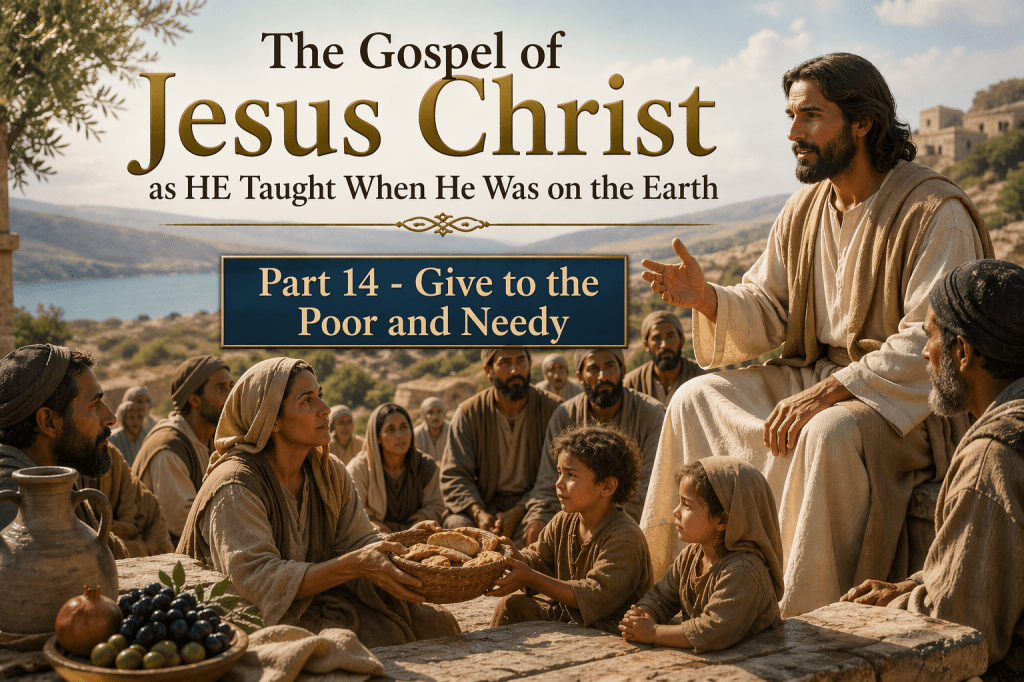
April 23, 2026 | http://www.gospelofjesuschrist.blog | River Wilde
(The views expressed here are my personal beliefs, shaped by extensive study of the Gospel of Jesus Christ as recorded in the Bible. I have prayerfully sought God’s guidance throughout my research to remain focused on truth. I do not speak on behalf of any religious organization.)
After losing my temple recommend, because I had given my tithing directly to those who needed help immediately, rather than just contribute to the financial empire of the church, I began to study the principle of Tithing, that Jesus Taught when He was on the earth.
The bishop stated that my tithing didn’t count, and had me surrender my temple recommend. Why didn’t it count? Paying tithing directly to a women’s center and a homeless shelter, which I had done, seemed to be more consistent with the teachings of Jesus Christ. It would provide immediate assistance to those who were suffering. Have you ever talked to someone who is experiencing domestic violence? They are in danger, and need a place to go and kept hide.
Providing food and counseling to individuals and their families has always felt far more important to me than directing my tithing to a church that, in my view, only appears to help the world through those funds.
When I first began studying the concept of tithing, I wasn’t trying to challenge it. My only question was whether tithing only “counted” if it was paid directly to the church. That single question led me into many nights of study and reflection.
I struggled deeply with the idea that, even though I was giving around 10% of my income to help the poor and those in need, I was told I could not hold a temple recommend and therefore could not participate in what I had been taught was God’s work in the temple. It didn’t feel right to me, and I couldn’t reconcile it.
That experience led me into a much deeper personal investigation of the gospel of Jesus Christ, and it changed everything I thought I understood.
I came to the conclusion that what I had been taught as the “restored gospel” was not aligning with what I was discovering through my study of Christ’s teachings. To me, they no longer felt like the same message at all.
Here is what I learned:
Tithing: From Old Testament Law to New Testament Grace
Old Testament Tithing
In the Old Testament, tithing was a formal, law-based system commanded by God for Israel. The word “tithe” means “a tenth,” and Israelites were required to give a tenth of their crops, livestock, and income to support the Levites, who had no land inheritance (Leviticus 27:30–32; Numbers 18:21–24).
Multiple tithes existed: one for the Levites, one for festivals in Jerusalem, and one every three years for the poor, widows, and strangers. Altogether, Israel’s obligations often exceeded ten percent.
Tithing functioned like a national religious tax, sustaining the temple, priesthood, and social welfare. God used tithing as a test of faithfulness, promising blessings for obedience and warning of consequences for neglect (Malachi 3:8–10). Under the Old Covenant, tithing was specific, structured, and tied directly to the nation of Israel.
New Testament Teaching on “Giving”
With Jesus Christ, the focus shifts from law to grace. The New Testament never commands a strict ten-percent tithe for Christians. Instead, giving is voluntary, Spirit-led, and rooted in love. When Jesus mentions the Pharisees’ tithing practices (Matthew 23:23), it is to expose hypocrisy, not to issue a legal mandate.
Early Christians gave freely to meet one another’s needs, often selling possessions to support the community (Acts 2:44–45; Acts 4:32–35). Paul instructed believers to give according to what they have, cheerfully and willingly (1 Corinthians 16:2; 2 Corinthians 8–9), emphasizing generosity from a transformed heart rather than obligation. It no longer was a “law” but rather a gospel principle of giving and love for one another.
Giving to the Poor as Giving to Christ
The New Testament prioritizes helping the poor and needy over institutional donations. Jesus says that serving the hungry, the naked, or the sick is equivalent to serving Him (Matthew 25:35–40). Paul himself never took tithes for ministry but organized collections solely for the poor (1 Corinthians 16:1–2; Romans 15:26; 2 Corinthians 8–9).
Let’s pause here for a moment.
After Christ’s death and resurrection, the apostles continued to preach the gospel He had taught. A central part of their message was caring for the poor and those in need. Their focus was not on building or funding an institution, but on living out the principle of charity—giving directly and sacrificially to those who were suffering.
They did not collect money for their own support or promote a system of financial obligation tied to ministry. Instead, they modeled generosity themselves, showing through their actions what it meant to serve without seeking personal or organizational gain. The emphasis was on giving, not on funding a religious structure.
In the teachings of Christ, worship was also transformed. There was no longer a requirement for a physical temple as the center of worship, because believers themselves were described as the temple of God. The relationship with God was no longer tied to a building or institution, but to a transformed life.
Christ did not establish a new religious organization in the way people often think of churches today. Rather, He established a new covenant and a living gospel centered on Him. The focus shifted away from maintaining a system or structure through financial support, and toward a direct, personal walk with God expressed through love, faith, and service.
The Jewish Law continued for those who did not believe in the teachings of Jesus Christ. And since those Jewish people were still living under the Old Covenant, their tithing continued as before. Jesus Christ CHANGED the “Law” into the concept of Giving. NO LONGER was it required to be 10%, No longer was it required to be paid to the Levites for the Nation of Israel. Jesus Changed that when He taught His new Gospel of GIVING.
The New Testament pattern is clear:
- No command for Christians to pay a 10% tithe.
- No instruction to give all donations to a centralized church body.
- Strong emphasis on giving directly to the poor, widows, and those in need.
- Giving is voluntary, Spirit-guided, and heartfelt—not a religious requirement.
From Law to Grace
The difference between Old and New Testament giving reflects the larger shift from law to grace. Under the Old Covenant, giving was regulated and enforced; under the New Covenant, giving flows from love, gratitude, and faith, not fear of punishment or hope of reward. Christian generosity arises from a saved life, not to earn salvation.
Salvation itself is by grace, not works or tithing. Paul explains:
“For by grace are ye saved through faith; and that not of yourselves: it is the gift of God: Not of works, lest any man should boast” (Ephesians 2:8–9, KJV).
Good works, including giving, are the result of salvation, not its cause (Ephesians 2:10). The New Testament affirms that no human effort, including mandatory tithing, determines eternal life.
For anyone questioning these doctrines, approach God with an open, teachable heart:
“If any of you lack wisdom, let him ask of God, that giveth to all men liberally… But let him ask in faith, nothing wavering” (James 1:5–6, KJV).
Reject fear-based, controlling church mandates. Christ’s yoke is easy and His burden light (Matthew 11:28–30). Salvation comes through faith and grace, and giving flows freely from that heart, bringing true freedom (John 8:31–32).
Jesus Christ taught a different gospel than what is taught in the Old Testament, and this includes tithing / giving.
I love the simplicity that Christ taught to us about HIS gospel. And even more so, I have great comfort in going to Him directly, as I learn His gospel…100% truth directly from Him and the teachings of the Bible.
If you’ve been taught that not being a full tithe payer means you will be burned at the Lord’s coming, it’s worth pausing and reconsidering that idea. That simply does not align with a true understanding of the Second Coming of Jesus Christ.
Christ returns to confront evil and ultimately to deliver and gather His followers. His purpose is rescue and redemption—not to punish those who belong to Him. Many who believe in Christ understand this event as a gathering or deliverance of His people, often referred to as the rapture, and tithing is not presented in scripture as a condition for that salvation or protection.
The God I believe in is not one who would destroy me for failing to pay money to an institution. That kind of teaching feels more like a man-made system of control than the message of Jesus Christ. In my view, it misrepresents His character and His gospel entirely.
Do you really believe the God you know would destroy His own children simply for not paying tithing? Step back and think about that for a moment. That kind of conclusion doesn’t line up with the character of Christ revealed in the Gospel. Be careful not to let fear-driven teachings shape your understanding of God. The message of Jesus Christ is not rooted in fear, but in love, mercy, and truth.
Any teaching that relies on fear as its foundation deserves to be carefully examined. Fear can be a powerful tool of control, but it is not the voice of Christ.
My hope is that this writing can encourage those who feel weighed down or controlled by fear-based religious teachings to reconsider what they’ve been told. This is not the nature of Jesus Christ.
It is my desire that through this research, and scripture teaching, it helps you understand the concept of tithing (Old Testament) and giving (New Testament teaching from Jesus Christ).
Religious Commercialization
Here are a few other KJV passages that speak directly to the issue of money, access to God, and religious authority:
1. Access to God is not bought
- Acts 8:20 (KJV)
“Thy money perish with thee, because thou hast thought that the gift of God may be purchased with money.”
- Isaiah 55:1 (KJV)
“…come, buy wine and milk without money and without price.”
These show that spiritual blessings and access to God are not something you pay for.
2. Jesus strongly opposed religious commercialization
- Matthew 21:12–13 (KJV)
“My house shall be called the house of prayer; but ye have made it a den of thieves.”
Jesus drove out those who were turning worship into a financial system. When I read this account, I can’t help but reflect on how closely it speaks to concerns I’ve personally felt about my own church experience.
It makes me pause and wonder how God feels when what is meant to be sacred becomes tied to money in any way. Even in Christ’s own words and actions, we see a clear response to this kind of misuse.
John 2:14–16 says:
“And found in the temple those that sold oxen and sheep and doves, and the changers of money sitting:
And when he had made a scourge of small cords, he drove them all out of the temple…
and said… Make not my Father’s house an house of merchandise.”
A few details stand out:
- Scourge refers to a whip
- Small cords likely refers to thin ropes that were available in the temple area, possibly used for tying animals
What stands out most is the intensity of Christ’s reaction. He wasn’t indifferent—He was clearly grieved and angered by what the temple had become.
For me, this raises an important question about modern practice. When access to sacred spaces is connected to financial requirements, it naturally invites reflection on whether that aligns with the spirit of Christ’s teachings.
From my own experience, I’ve wrestled with the idea that tithing must be paid in a very specific way in order to “count,” and that access to the temple is tied to that requirement. That has felt, at times, like a system where something deeply spiritual becomes linked to financial qualification.
I share this not as a final judgment, but as an honest reflection prompted by the scriptures and my personal experience, and how closely it seems to echo the warning Jesus gave about turning sacred things into “merchandise.”
3. Giving is meant to be willing—not compelled
- 2 Corinthians 9:7 (KJV)
“Every man according as he purposeth in his heart, so let him give; not grudgingly, or of necessity…”
- 1 Peter 5:2 (KJV)
“…not for filthy lucre, but of a ready mind.”
Giving should always flow from the heart, not be reduced to a requirement tied to access or privileges. In my view, when financial contributions become a condition for spiritual participation or worthiness, it raises serious concerns when measured against the teachings of Christ—who consistently presented God’s grace as freely given.
When access to sacred experiences is linked to financial requirements, it can feel at odds with the message that God’s gifts are not purchased, earned, or reserved for those who can pay. That kind of structure can, in some cases, resemble the kind of exploitation warned about in passages like 2 Peter 2:3, depending on the intent and how it is applied.
I invite you to adhere to the teaching of Jesus Christ relating to Tithing / Giving. All of us can see the need in the world today, even in our circle of friends, and community. People need our help. Reach out to them directly to give your offerings, not a religious organization.
The poor and needy are the ones that Christ was teaching us to help, not an institution. He did not share this concept with us so that we could build the financial empire of a church or a preacher.
In doing so you will see such a difference in the understanding of what He taught. We give out of love, and not out of a requirement to do so.
So why is truth being revealed right now? I have been religious all of my life, and just learning the true teachings of Jesus Christ. Join me again tomorrow as we discuss this end times prophecy that all truth will be exposed in the last days www.gospelofjesuschrist.blog
Discover more from The Gospel of Jesus Christ
Subscribe to get the latest posts sent to your email.


So true…
”The focus shifted away from maintaining a system or structure through financial support, and toward a direct, personal walk with God expressed through love, faith, and service.”
and…
”Any teaching that relies on fear as its foundation deserves to be carefully examined. Fear can be a powerful tool of control, but it is not the voice of Christ.”
I remember the fear tactics. We used to hear stories like, someone stopped wearing their temple garments and then they had a car wreck! Or other such stories. One time years ago while driving on a trip without air conditioning through an area of 112 degrees, I stopped at a rest area and went into the restroom. I took off those garments and realized then and there I didn’t believe in a God that needed me to wear special under garments for protection.
Now, as believers in Christ we give money to a homeless shelter that really helps people to get off the streets, freedom from addictions, and finding new life in Jesus Christ. As well as various ministries as the Spirit leads. And we do give to our little church for our pastor who loves Jesus and those he serves, community outreach, the missionaries and local food bank our church supports. But no one keeps track of our financial giving.
Thanks again for a true, biblical, and encouraging message.
LikeLiked by 1 person
Thank you for sharing.
LikeLike